

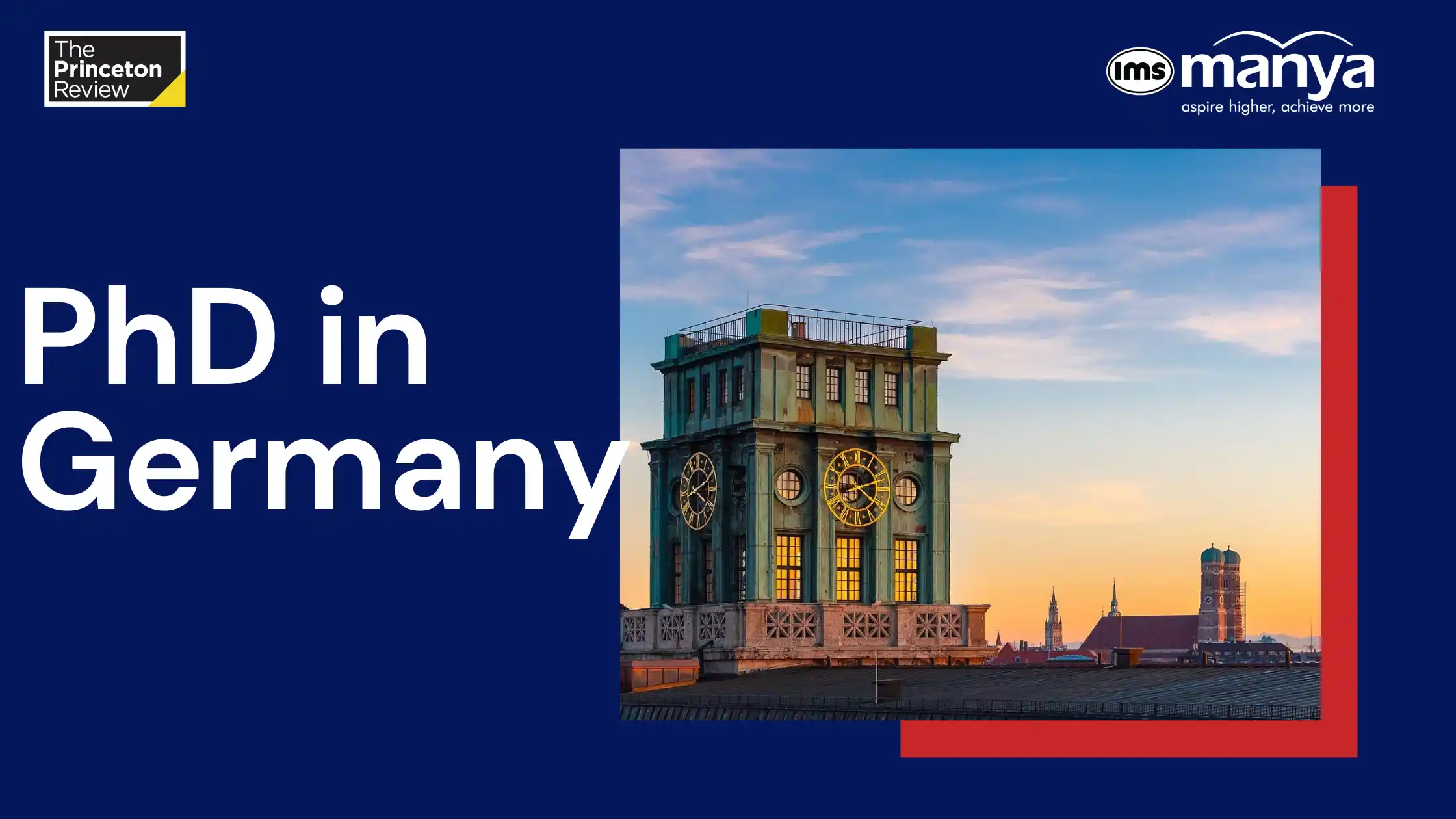
Every year, more than 28,000 graduate students complete their doctorate in Germany. Various German universities award a doctoral degree to more than 5800 international scholars every year.
Various research institutes, research universities, technical universities, and other research networks offer a PhD in Germany.
Overview Table
| Aspect | Details |
| Types of PhD programs | Traditional PhD programs
Structured PhD programs |
| Duration | 3-5 years |
| Specializations |
|
| PhD Institutes |
|
| Tuition Fees | No tuition fees fora PhD in Germany at public German universities for all nationalities for 3 years (6 semesters) |
| Best cities for a PhD in Germany |
|
| Eligibility |
|
Top Universities for PhD in Germany
Enlisted below are some of the top universities for a PhD in Germany, along with their QS World University Ranking and specializations.
| QS World University Ranking 2026 | Name of University | Specializations |
| 22 | Technical University of Munich | Medical Life Science and Technology, Experimental Medicine, Life Sciences, Sport and Health Sciences |
| 58 | LMU Munich | Life Science – From Molecules to Systems, Medical Research in Epidemiology and Public Health, Culture and History, Buddhist Studies |
| 80 | Heidelberg University | Neurosciences, Molecular Biology, Biochemistry, Organismal Studies |
| 88 | Free University of Berlin | North American Studies, East Asian Studies |
| 98 | Karlsruhe Institute of Technology | Optics and Photonics, HEiKA Graduate School on Functional Materials |
Why Pursue a PhD in Germany?
There are several reasons why candidates aim to pursue a PhD in Germany.
Dedicated research institutes
Germany has dedicated research institutes, where students can pursue their PhD in their choice of subject with cutting-edge research projects.
Globally ranked institutions and universities in Germany for PhD
Numerous German institutes and universities are globally ranked and well-known for their PhD programs. Some are the Technical University of Munich, LMU Munich, Heidelberg University, University of Bonn, and many more.
Affordability with no tuition fees for PhD students
The majority of international PhD students do not need to pay any tuition fees for the PhD program. This is applicable for 3 years (6 semesters).
Max Planck Schools
Max Planck Schools are a strong network that brings together international PhD students and Germany’s best scientists and researchers.
Large international student community
The large international student community is an advantage for knowledge enhancement and fruitful discussions on various research topics and subjects.
Strong economy with investments in research and development
Germany has a strong economy, and a lot of investments are being made in research and development in various fields. This broadens the PhD scope for interested research candidates.
Admission Checklist for a PhD in Germany
| Requirements | Details |
| Research proposal | Detailed research proposal, including research topic, methodology, objectives, and significance |
| Statement of Purpose (SOP) | Statement of purpose citing the reason for pursuing a PhD in the given subject, with academic and career goals |
| Copy of Master’s Thesis | Copy of Master’s thesis displaying research skills and academic work depth |
| Educational Certificate | Bachelor’s or Master’s degree, equivalent to a German Master’s degree |
| Resume/CV | Detailed CV with academic achievements, research experience, publications, etc. |
| Letters of recommendation | Recommendation letters from academic advisors attesting to your academic potential |
| English Language Proficiency | TOEFL / IELTS / TestDaF |
| Passport | Valid International passport with a valid student visa (if needed) |
Fees for a PhD in Germany
| Name of University | Fees |
| Technical University of Munich | No tuition fee for PhD students |
| LMU Munich | No tuition fee for PhD students. However, there is a semester fee of 85-100 Euros. |
| Heidelberg University | Semester fee of €161 |
| Free University of Berlin | No tuition fee for PhD students. However, there is a semester fee of around 360 Euros. |
| Karlsruhe Institute of Technology | No tuition fee, semester contribution is around 200 Euros per semester. |
Eligibility for a PhD in Germany
Candidates looking to pursue a PhD in Germany must fulfil the following criteria:
- A Bachelor’s or a Master’s degree, equivalent to a German Master’s degree.
- As per the German grading scale, scoring a final grade point average of a minimum of 2.5. This is equivalent to B+ or ‘Good’.
- For studying in English, proof of English proficiency with the TOEFL or IELTS test. For studying in the German language, proof of German proficiency like TestDaF.
- Finding an academic supervisor.
- The doctoral thesis should be in sync with the main PhD program.
PhD Intakes and Application Deadlines
| University | Intake Deadlines |
| Technical University of Munich | There is no general deadline for PhD applicants. Candidates have to contact potential supervisors via email. |
| LMU Munich | Typically 15th January/15th July for the following semester |
| Heidelberg University | There is no general deadline for PhD applicants. Candidates have to contact potential supervisors via email. |
| Free University of Berlin | No application deadline for most of the programs, for some programs it is mid-November. |
| Karlsruhe Institute of Technology | There is no general deadline for PhD applicants. Candidates have to contact potential supervisors via email. However, in some cases, it is the end of January. |
Scholarships for a PhD in Germany
PhD students in Germany have funding options through scholarships from universities, research institutes, non-profit organizations, and government or industry partners.
| Name of the scholarship | Eligibility Criteria | Details |
| Max Planck Society Research Scholarships | Open to all nationals | International applicants with a relevant Master’s degree, a strong academic record, no prior PhD, English proficiency, limited residency in Germany, and research motivation |
| DAAD – PhD Scholarships in Germany | Supports almost 100,000 researchers and international students pursuing PhD, Postdocs, etc. |
|
Job Opportunities after a PhD in Germany
Once you complete a PhD in Germany, various career paths open up. Some prominent ones are as follows:
- Postdoc positions at various non-university research institutes, universities, and other organizations
- Research Group Leader in managing a research team, etc.
- Independent Researcher leading to management and other positions
- Professor for full-time jobs in universities and research institutes
Top Recruiters for PhD in Germany
Top recruiters hiring PhD candidates in Germany include the following:
| Recruiter Name | Field of Recruitment |
| BMW Group | Research Science, Laboratory Research |
| Deutsche Group | Data, Business, Operations Analysis |
| Volkswagen | Software, Coding, Motor Engineering |
| Bosch Group | Technology, Engineering |
| Uniper | Energy Transformation, Environmental Technology |
Frequently Asked Questions
What is the approximate time duration for completing a PhD in Germany?
On average, it takes about 4-5 years to complete the doctorate. However, the timeline might vary depending on various factors.
Is TOEFL or IELTS needed for universities in Germany for a PhD?
If you want to pursue a PhD in English and English is not your first language, you will have to prove your proficiency in the language by clearing either the IELTS or TOEFL test.
What career options open up after a PhD in Germany for Indian students?
Candidates completing a PhD in Germany can work on various projects or in research groups in German universities or research institutes.
Can candidates work while pursuing a PhD in Germany?
Candidates can work for an establishment or company or on some research project and pursue their PhD program simultaneously.
Is a PhD in Germany offered in the German language only?
No, you can pursue a PhD in Germany in English or the German language. However, candidates have to prove the required and appropriate language proficiency while choosing the university and specialisation.