

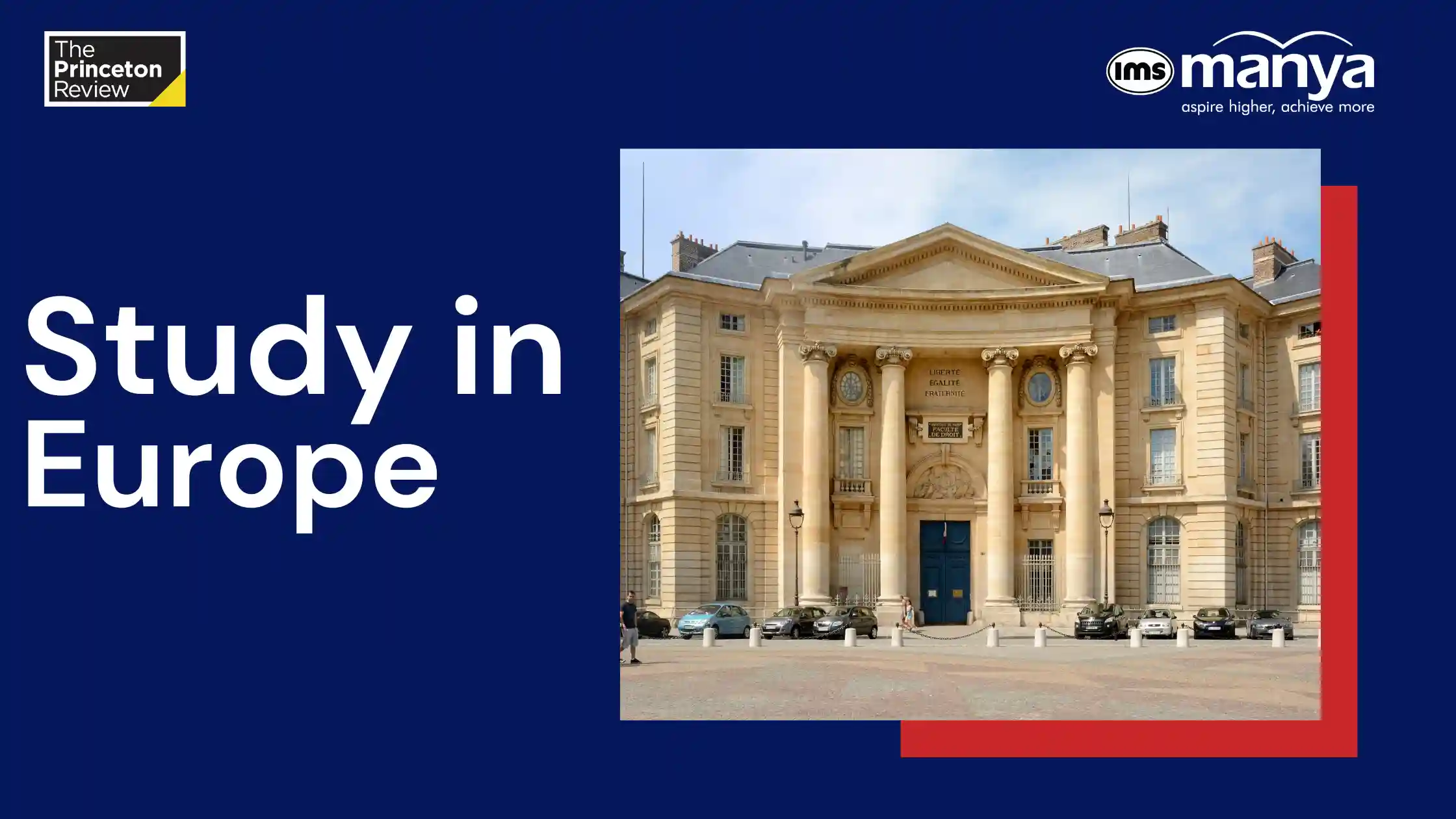
Europe has one of the world’s oldest and most well-known education systems. Many European countries offer Bachelor’s, Master’s, and Ph.D. degrees in various subjects. Many universities now have programs where English is the main language, so you don’t have to worry about learning another language. Only a few programs are not taught in English, making studying there easier for international students.
Overview
| Aspect | Details |
| Exams | IELTS, TOEFL, GRE, GMAT, SAT |
| Dates | Year-round, varies by exam and location |
| Eligibility | Academic scores, SOP, LOR, Language tests |
| Popular Destinations | Germany, UK, France, Sweden, Italy, Netherlands, Ireland |
| Bologna Process | The Bologna Process was established in 1999 to bring more coherence to European higher education systems. 49 countries are currently members of the Bologna Process. It established the EHEA (European Higher Education Area) with 3 primary goals:
|
| European Higher Education Area Members | Some full members of the EHEA are France, Finland, Germany, Spain, and the UK. |
| Free Universities in Europe | Humboldt University of Berlin,
Ludwig Maximilian University of Munich (LMU), Technical University of Berlin, University of Bonn |
| Costs | Tuition and living costs vary by country |
| Documents | Transcripts, passport, financial proof, visa, etc. |
| Visa | Acceptance letter, insurance, language scores, proof of funds |
| Deadlines | Open 6-12 months before program start |
| Languages | English, German, French, or local languages |
| Popular Courses | Engineering, Business, Arts, Medicine, etc. |
Reasons to Study in Europe
Here’s why studying in Europe could be a great choice for you:
- Wide Range of Programs: You can find many courses in English, including Business, Science, and Engineering.
- Affordable Education: Many universities in Europe offer free or low-cost tuition, making it cheaper than places like the US.
- Erasmus+ Program: This program helps students and teachers move between universities in Europe, giving you a chance to study in different countries.
- Top-Quality Education: Europe is home to five of the top ten universities in the QS World University Rankings 2026, showcasing its excellence in higher education.
- Chance to Travel: With a Schengen visa, you can easily visit up to 26 countries while studying.
- Networking Opportunities: You’ll meet people from all over the world, which could help you connect with companies and build a career.
- Learn a New Language: Studying in Europe gives you a chance to build your language skills, which can be helpful for your future.
- Specialised Training: Europe is known for its excellent programs in fields like business, medicine, and finance, which give you the skills and experience you need.
- Globally Recognised Degrees: A degree from a European university is accepted worldwide, making it easier to get jobs in different countries.
Top Countries to Study in Europe
Here is a list of some of the top countries in Europe that you can study in:
| Country | Key Features |
| United Kingdom | ● Multicultural society
● World-renowned universities ● Global networking opportunities |
| France | ● World-class education
● Popular among international students ● Stay-back and work opportunities |
| Germany | ● Low to no tuition fee
● Reasonable cost of living ● Strong economy and job market |
| Switzerland | ● High safety
● Low unemployment rate and high income ● High quality of life |
| Italy | ● Centuries-old, world-renowned universities
● Strategic location in Europe ● Global business hub |
Most Affordable Countries to Study in Europe
Here is a list of some of the cheapest universities that you can study at in Europe:
| Country | Top Universities |
| Germany | Humboldt University of Berlin, Ludwig Maximilian University of Munich, and the Technical University of Munich |
| Norway | University of Oslo, Norwegian University of Science and Technology, University of Bergen |
| Ireland | Trinity College Dublin, University College Dublin, University College Cork |
| Austria | University of Vienna, Graz University of Technology, Vienna University of Economics |
| Poland | University of Warsaw, Jagiellonian University, Warsaw University of Technology |
Best Universities to Study in Europe
Here is a list of some of the top universities that you can study at in Europe:
| Ranking | University Name | Country |
| 2 | Imperial College London | United Kingdom |
| 4 | University of Oxford | United Kingdom |
| 6 | University of Cambridge | United Kingdom |
| 7 | ETH Zurich | Switzerland |
| 9 | University College London (UCL) | United Kingdom |
| 22 | Technical University of Munich | Germany |
| 28 | Université PCL | France |
Popular Courses in Europe
Popular courses in Europe include:
- Business and Management: Widely offered across universities, focusing on entrepreneurship, marketing, finance, and international business.
- Engineering: With specialisations in civil, mechanical, electrical, and computer engineering, it remains a top choice for students.
- Computer Science: In demand due to the growing tech industry, focusing on AI, data science, software development, and cybersecurity.
- Medicine: Offered in many European countries, often in English, attracting international students due to lower fees and high-quality education.
- Law: European law degrees are popular, especially for international or EU law students.
- Social Sciences: Including sociology, psychology, and political science, these courses are commonly offered across European institutions.
- Arts and Humanities: History, philosophy, literature, and languages remain popular among students in various European universities.
Eligibility Criteria to Apply in Europe
The following are some of the typical eligibility criteria for study in Europe:
| Eligibility Criteria to Apply in Europe | Details |
| Academic Qualifications | High school for undergraduate courses; bachelor’s degree for postgraduate courses. |
| English Proficiency | At least IELTS (6.0-6.5), TOEFL (80+), or equivalent tests. |
| Letters of Recommendation (LOR) | Required for most courses. |
| Statement of Purpose (SOP) | Explains motivation and academic goals. |
| Curriculum Vitae (CV)/Resume | Details academic and professional background. |
| Additional Documents | Portfolio, work experience, or research proposal (if applicable). |
| Entrance Exams/Interviews | Required for some programs; varies by course. |
| Proof of Funds | Demonstrates financial ability to cover tuition and living expenses. |
Intake of Applications
| University Name | Intake deadline |
| Imperial College London |
|
| University of Oxford |
|
| University of Cambridge |
|
| ETH Zurich |
|
| University College London (UCL) |
|
Fees for Top Universities in Europe
The following are the fee details for some of the popular universities in Europe:
| University Name | Fees (depending on course) |
| Imperial College London | £38,000 – £81,000 |
| University of Oxford | £30,000 – £90,000 |
| University of Cambridge | £25,000 – £45,000 |
| ETH Zurich | CHF 4,380 per year |
| University College London (UCL) | £37,500 – £65,000 |
| Université PCL | €343 – €480 (CVEC only) |
| University of Edinburgh | £26,500 – £41,500 |
Scholarships for International Students
Here are some scholarships you can apply for to access some of the cheapest countries to study in Europe :
| Scholarship | Details |
| Erasmus Mundus Scholarships (EU) | The scholarship gives a monthly stipend for living costs, travel expenses, health insurance, and participation costs for the Erasmus program. |
| DAAD Scholarships (Germany) | This provides a monthly scholarship payment and a travel allowance. It also may offer additional benefits such as research allowance, health and accident insurance, etc. |
| Holland Scholarship (Netherlands) | Scholars receive a scholarship amount of € 5,000 in the first year of their studies. |
| Swedish Institute Scholarships (Sweden) | Fully funded scholarship options for over 700 programs in the country |
| Chevening Scholarships (UK)
|
Fully funded scholarships, including flights, accommodation, and tuition fees |
| Università Bocconi Scholarships (Italy)
|
Fully funded scholarship providing a waiver of up to € 12,000 per year (for UG) and € 13,000 per year (for PG) and accommodation. |
What To Do After Studying In Europe
Here are some potential job opportunities after pursuing an education in Europe:
| Course | Job Opportunities |
| Business and Management | Business Analyst |
| Project Manager | |
| Business Advisor | |
| Engineering | Civil Engineer |
| Software Engineer | |
| Data Engineer | |
| Computer Science | Applications Analyst |
| Cyber Security Analyst | |
| Data Analyst | |
| Arts and Humanities | Editor |
| Multi-media Specialist | |
| Linguist | |
| International Relations Specialist | |
| Social Worker |
Top Recruiters in Various Fields in Europe
Here are the top recruiters for students from various study fields in Europe:
| Field | Top Recruiters |
| Tech | |
| Microsoft | |
| SAP | |
| Finance | Deloitte |
| JP Morgan | |
| BNP Paribas | |
| Engineering | Siemens |
| Bosch | |
| ABB Group | |
| Healthcare | Roche |
| Novartis | |
| Bayer | |
| Automative | BMW |
| Volkswagen | |
| Tesla | |
| Hospitality | Hilton |
| Marriott | |
| Accor | |
| Retail | H&M |
| Ikea | |
| Unilever |
Conclusion
To sum up, studying in Europe gives you a chance to get a top-quality education while experiencing different cultures. Many universities have affordable fees, and many programs are taught in English. Europe has some of the best universities in the world, making it a great place to study. Whether you’re interested in science, the arts, or business, you’ll find plenty of options to match your goals and interests.
Frequently Asked Questions (FAQs)
Can I work while studying in Europe?
Many universities allow part-time jobs or internships, helping you gain work experience while studying.
Can I stay in Europe after graduation?
Some of the best countries to study in Europe offer options to stay back after your study period is over. For example, a Graduate visa in the UK allows you to stay in the country for 2 years if you apply on or before 31 December 2026 & 18 months if you apply on or after 1 January 2027, after completing your course, post which you can switch to another Visa. In case of Germany, the stay back post completing a UG/PG program is 18 months.
Is it easy to get a student visa for Europe?
It depends on the country, but most European countries have transparent student visa processes. Make sure to check each country’s requirements.
How long does it take to get a degree in Europe?
A bachelor’s degree typically takes 3 to 4 years, while a master’s degree typically takes 1 to 2 years.
Do I need to speak the local language to study in Europe?
Many universities offer programs in English, so you don’t always need to speak the local language, but it’s helpful for everyday life and connecting with people.