
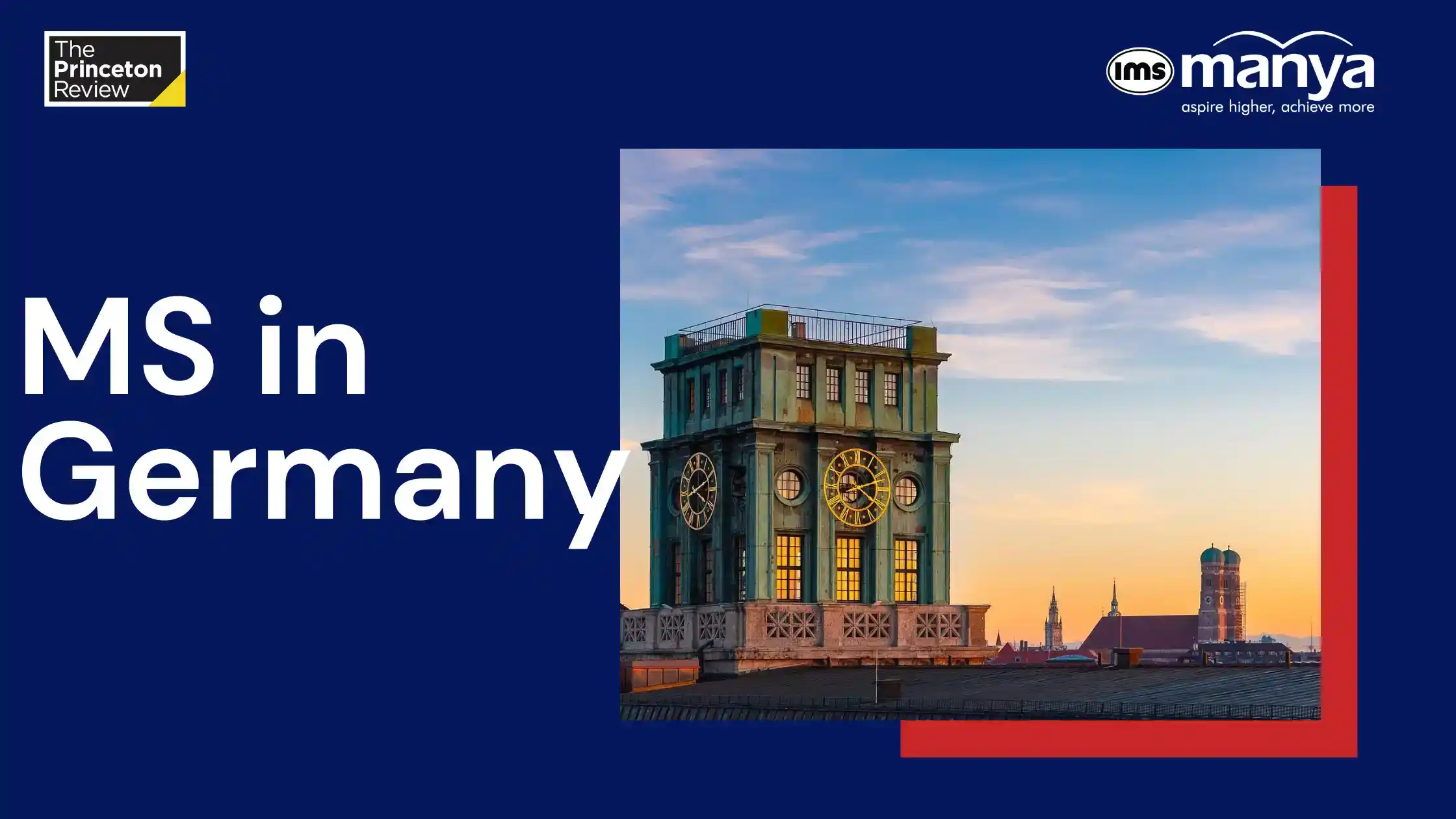
Pursuing an MS in Germany is easier than you think and will usher in numerous lucrative job opportunities your way. Thousands of students aim to take up an MS in this country because of its strong focus on research and industry collaboration. They additionally offer unique opportunities for innovation in the top-tier market and industrial sectors.
An MS in Germany typically lasts 2 years and is highly accessible. Most are tuition-free or low-cost, hence the ever-rising demand.
Overview Table
| Category | Details |
| Duration | 1.5 years or 2 years |
| Credit system | 90 ECTS or 120 ECTS |
| Grading system | Grades: 1 to 5
1 – Highest grade 5 – Lowest grade |
| Eligibility criteria |
|
| Academic year | Winter Semester: October-March
Summer Semester: April-September |
| Top colleges | TUM, Ludwig Maximilian University of Munich, Heidelberg University, Freie University Berlin, RWTH Aachen, TU Berlin, TH Ingolstadt, University of Freiburg, Karlsruhe Institute of Technology |
| Popular courses | Engineering, Computer Science, Natural Sciences |
Top Public Universities for MS in Germany
| University Name | QS World University Ranking 2026 | Overall Score |
| Technical University of Munich (TUM) | 22 | 90.2 |
| Ludwig Maximilian University of Munich | 58 | 80.1 |
| Heidelberg University | 80 | 73.0 |
| Freie University of Berlin | =88 | 71.1 |
| Karlsruhe Institute of Technology | =98 | 69.1 |
| RWTH Aachen University | =105 | 67.6 |
| Humboldt-Universität zu Berlin | 130 | 64.5 |
| Technische Universität Berlin (TU Berlin) | 145 | 62.8 |
| University of Hamburg | 193 | 56.5 |
| University of Freiburg | 201 | 55.6 |
Why Study MS in Germany?
Here’s a list of reasons why you should study an MS in Germany:
- High-ranking universities: German universities are renowned for their high-quality education and strong focus on research and practice-oriented programs.
- Affordable Tuition: Most public universities in Germany charge little to no tuition fees, even for international students.
- Post-Graduation Opportunities: Germany offers an 18-month post-study work visa, helping graduates secure jobs and settle.
- Access to Europe: Being in the Schengen area allows easy travel across Europe for both academic and leisure purposes.
Admission Checklist for MS in Germany
This table highlights the admission checklist for MS in Germany:
| Stage | Task | Details / Notes |
| Program Selection | Choose an MS specialization. | Select a field aligned with a bachelor’s degree, as Germany does not entertain a change in domain. |
| Select the language of instruction. | English-taught or German-taught | |
| Shortlist universities | Public / Private universities | |
| Verify eligibility | Check Anabin recognition | |
| Confirm intake | Winter (Sep/Oct) / Summer (Mar/Apr) | |
| Academic Requirements | Bachelor’s degree | Relevant undergraduate degree |
| Minimum GPA | As per the university requirement | |
| Subject credit requirements | Mandatory for technical programs | |
| Language Proficiency | English test | IELTS (6.5+) / TOEFL (80–90+) and above as per the university requirements |
| German test | TestDaF / DSH / Goethe (A1–C1) as per the university requirements | |
| Document Preparation | Academic transcripts | All semesters |
| Degree certificate | Provisionally accepted in some cases. | |
| CV | Europass format preferred | |
| Statement of Purpose | Program-specific | |
| Letters of Recommendation | 3 to be on the safer side, while the majority of the universities need only 2 LORs | |
| Passport | Valid passport copy | |
| APS Certificate | Mandatory for India/China/Vietnam | |
| GRE score | If required by the university | |
| Application Submission | Apply via Uni-Assist or University Portal | Pay application fees |
| Upload documents | Verify completeness | |
| Track application status | Respond to university emails. | |
| Deadlines | Winter intake deadline | Dec – mid July |
| Summer intake deadline | July – mid Jan | |
| Admission Process | Receive the offer letter | Conditional / Unconditional |
| Accept admission | Within the given deadline | |
| Pay the semester contribution | €100–€500 as per the university | |
| Financial Proof | Open a blocked account | €11,904 for one year of living expenses |
| Arrange funding | If the university charges a tuition fee (which will vary from university to university) | |
| Student Visa | CSP Portal Registration | Sign up with your email id and fill in the details |
| Prepare visa documents | Admission, finance, insurance | |
| Submit CSP Application | Review of your application by the authorities | |
| Book a Visa Appointment | Select the date and time as per the appointment availability. | |
| Attend the appointment and pay the visa fees | Biometrics + Visa Application Fees | |
| Pre-Departure | Arrange accommodation | Student dorm / private housing |
| Book flight tickets | After visa approval | |
| Prepare documents | Originals + copies | |
| Learn basic German | A1 level recommended (even if going for a program completely taught in English) |
Fees for International Students for MS in Germany
Here’s a table highlighting the fees of the top 5 universities that offer an MS in Germany:
| University Name | Per Semester Fee | Tuition Fees in INR |
| Technical University of Munich | €4,000 – €6,000 | 4.4L – 6.6L |
| Heidelberg University | €1500 tuition fees + €161 enrollment fees | 1.8L |
| RWTH Aachen University | €360 | 39.6K |
| TH Ingolstadt | €1,200 tuition fees + €72 enrollment fees | 1.4L |
| SRH Hochschule Berlin | €6,950 | 7.6L |
Eligibility for MS in Germany
The following table highlights the necessary eligibility criteria for pursuing an MS in Germany:
| Eligibility Criteria | Details |
| Bachelor’s Degree | A credible undergraduate degree (usually 4 years) from an accredited institution in a relevant field. |
| Minimum Academic Scores | GPA or percentage requirements will vary from university to university |
| Language Proficiency | English-taught Programs: IELTS (6.5+) or TOEFL (90+) scores are commonly accepted. A few universities also need A1 or A2 German language certificate as part of the application.German-taught Programs: TestDaF, DSH, or Goethe-Zertifikat certification is needed for German proficiency. |
| APS Certificate | Compulsory for students from countries like India to verify their academic qualifications. |
| GRE/GMAT Scores (Optional) | Some universities or programs may require GRE/GMAT scores as an additional criterion. Although this may be optional, it can give applicants a competitive edge. |
| Relevant Work Experience (Optional) | Some institutes may ask for work experience as an admission criterion. |
| Statement of Purpose (SOP) | A well-written SOP where you explain your career goals and motivation to join the program. |
| Letter of Recommendation (LOR) | 2 LORs from any academic or professional references. (Recommended to have 3 LORs to be on the safer side) |
| Resume or CV | An up-to-date resume with your academic achievements, work experience, and internships. |
MS Intake and Admission Deadlines
Here are the intake and admission deadlines for the top 5 universities for MS in Germany:
| University Name | Semester Intake | Application Deadline |
| Technical University of Munich | Winter | Feb 01 – May 31 (Depending on the program) |
| Summer | Sep 01 – Nov 30 (Depending on the program) | |
| University of Stuttgart | Winter | Nov 15 – Jan 15 |
| Summer | May 15 – Jul 15 | |
| RWTH Aachen University | Winter | Dec 01 – Mar 01 |
| Summer | Jun 01 – Sep 01 | |
| Karlsruhe Institute of Technology | Winter | July 15 |
| Summer | Jan 15 | |
| SRH Hochschule Berlin | Winter | Rolling, but better to apply before May 15 |
| Summer | Rolling but better to apply before Dec 15 |
Scholarships of MS in Germany
| Scholarship | Description |
| DAAD Scholarship Programs | Available for students from all over the world. |
| Heinrich Böll Foundation Scholarships | Open to master’s students of all nationalities. |
| Erasmus+ Scholarship Programs | Available for students in master’s programs who want to participate in an exchange program in Germany. |
| Friedrich Ebert Foundation Scholarships | For students who are accepted into a state or state-recognized German university. |
| MBA Scholarships | Offered by many top-notch business schools in Germany. |
Job Opportunities after an MS in Germany
Pursuing an MS in Germany can open up numerous opportunities for career growth:
| Employment Opportunities | Germany has a high demand for experts, especially in healthcare, engineering, and IT.
International graduates can apply for the Job Seeker Visa, allowing up to 18 months to find a job related to their field of study. |
| Blue Card Eligibility | After employment, you are eligible to apply for the EU Blue Card, which will not only make it easy for you to settle in Germany but offers EU-wide mobility. |
| Research & PhD | If you are interested in academia or research, you can pursue a PhD. |
| Return to Home Country | Graduates can use their German education and experience to bag high-paying job roles in their native country. |
| Start a Business | Germany is a great place for entrepreneurship. You can explore options for starting a business or a startup in the country after graduation. |
| Further Studies | You can also pursue additional certifications or another advanced degree. |
Top Recruiters for MS Graduates in Germany
| Top Recruiters | Industry | Notable Roles Offered | Approx. Starting Salary | Top Hiring Locations |
| Siemens AG | Engineering & Tech | Systems/Project Engineer, Automation & Digital Solutions, Software | ~€60,000 – €85,000/yr gross (higher end for tech/engineers) | Munich, Berlin, Erlangen, Nuremberg |
| Bosch GmbH | Engineering / Electronics | R&D Engineer, Software/Embedded Dev, Product/Automation | ~€55,000 – €75,000/yr | Stuttgart, Munich, Bamberg, Reutlingen |
| BMW Group | Automotive | Engineering, Data Analyst, Production/Logistics Specialist | ~€54,000 – €66,000/yr (mech. engineering roles) | Munich, Regensburg, Dingolfing |
| Volkswagen Group | Automotive | R&D Engineer, Supply Chain Analyst | ~€52,000 – €64,000/yr | Wolfsburg, Ingolstadt, Stuttgart |
| Mercedes-Benz Group | Automotive | Engineering, Production & Tech Specialist | ~€55,000 – €67,000/yr | Stuttgart, Sindelfingen, Bremen |
| Airbus (Germany) | Aerospace & Defense | Aerospace Engineer, Systems Integration | ~€58,000 – €70,000/yr | Hamburg, Bremen |
| SAP SE | Software / Enterprise Tech | Software Engineer, Consultant, Product/Cloud Developer | ~€65,000 – €85,000/yr | Walldorf, Berlin, Munich |
| BASF SE | Chemicals & Materials | Process/R&D Engineer, Sustainability/Technical Specialist | ~€55,000 – €75,000/yr | Ludwigshafen |
| Bayer AG | Pharmaceuticals | Research Scientist, Regulatory Affairs, Product Dev | ~€55,000 – €80,000/yr | Leverkusen |
| Deutsche Telekom AG | Telecom / IT | Network Engineer, Software Developer, Cybersecurity | ~€55,000 – €75,000/yr | Bonn, Berlin, Munich (national offices) |
| Rheinmetall AG | Defence & Tech | Systems & Industrial Tech Roles | ~€60,000 – €85,000/yr | Düsseldorf & nationwide hubs |
| Google Germany | Technology | Software Engineer, Product Manager, Data Scientist | ~€65,000 – €100,000/yr | Berlin, Hamburg, Munich |
| Amazon (DE) | E-Commerce / Tech | Software Dev, Operations Manager, Data Analyst | ~€60,000 – €85,000/yr | Berlin, Munich |
Frequently Asked Questions (FAQs)
Can one work a part-time job while pursuing an MS in Germany?
Yes, international students are allowed to work up to 120 full days or 240 half days per year.
What is a blocked account, and why is it needed to pursue an MS in Germany?
A blocked account is a special bank account for international students in Germany that does not allow one to withdraw the full amount at once. It proves to German authorities that you have sufficient funds to support yourself while studying.
As of Jan 2026, one needs to have €11,904 in a block account for their living expenses. (Monthly withdrawal capped at max. €992)
Do you need to learn German as a mandate if you are an international student of an MS in Germany?
It entirely depends on what program you are going for. Many MS courses are taught in English, but knowing German can be beneficial for daily life and working part-time jobs. Also, certain universities need international students to submit a German A1 language certificate or a German A2 language certificate as part of the application.
What is the process of applying for a post-study work visa in Germany?
Once you complete your MS in Germany, you can hunt for relevant jobs by applying for an 18-month job-seeker Visa. Once employed, you can move on to a residence permit for further employment.
Can one apply for Permanent Residency after completing an MS in Germany?
Some of the top MBA specialisations in Germany include healthcare, finance, marketing, accounting, human resources, international business, and project management.