

SAT Exam 2026: Test Dates, Format, Structure, Fees, Timing & Preparation Tips
Dreaming of studying at a top university in the US or Canada? For Indian students, the SAT exam 2026 is one of the important steps in the admission journey. A strong SAT score can help boost the chances of getting into prestigious institutions and also securing scholarships. That’s why having the right SAT preparation strategy is essential to stand out in the competitive admission process.
With recent updates from the College Board, the SAT has transitioned from a lengthy paper-based format to a shorter, faster, and fully digital SAT exam. The first essential step is understanding the SAT exam pattern and SAT syllabus 2026. This guide shall cover everything you need to know about SAT exam in India- from structure and syllabus to SAT preparation tips- to help you kickstart your journey towards global education!
Understanding the SAT- An Overview
The SAT exam pattern is designed to evaluate students’ core skills in Reading, Writing, and Mathematics, ensuring they are prepared for the academic challenges of college. Understanding the SAT exam structure is the first step toward adequate SAT preparation and achieving a high score.
| SAT Overview | Details |
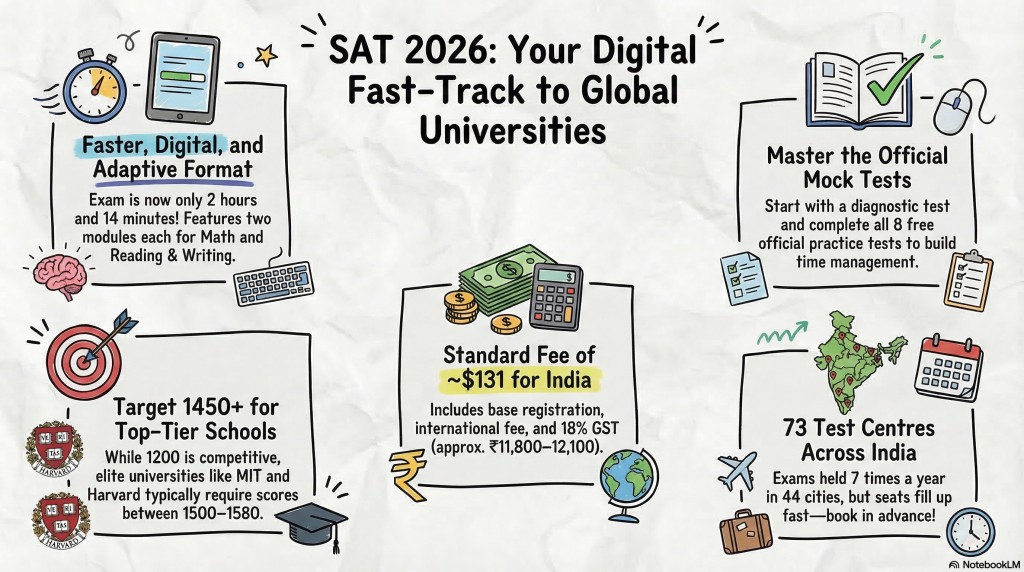
| Total Test Duration | 2 hours 14 minutes |
| Total Number of Sections | 2 – Math, Reading & Writing |
| Total Number of Questions | 98 |
| Scoring Range | 200–800 per section (Total: 400–1600) |
| Test Format | Fully Digital (Computer-Based) |
| Breaks | One 10-minute break between sections |
| Test Frequency | Conducted 7 times a year worldwide |
| Score Validity | 5 years |
Read More: SAT Syllabus
SAT 2026 Test Dates & Deadlines
Are you planning to take the SAT exam in 2026? Staying updated with the official test dates and registration deadlines is essential for Indian students aiming to apply to top universities abroad. The College Board has announced the SAT 2026 schedule, including regular and late registration deadlines so that you can plan your preparation and application:
| Test Date | Registration Deadline | Late Reg./Changes | Score Release (Est.) |
|---|---|---|---|
| March 14, 2026 | February 27, 2026 | March 3, 2026 | March 28–April 3 |
| May 2, 2026 | April 17, 2026 | April 21, 2026 | May 16–22 |
| June 6, 2026 | May 22, 2026 | May 26–27, 2026 | June 20–26 |
The estimated SAT 2026 dates for the rest of the year are as follows:
| Test Date | Registration Deadline | Late Reg./Changes | Score Release (Est.) |
|---|
| August 22, 2026 | August 7, 2026 | August 11, 2026 | September 4, 2026 |
| October 3, 2026* | September 18, 2026* | September 22, 2026* | October 16, 2026* |
| November 7, 2026* | October 23, 2026* | October 27, 2026* | November 20, 2026* |
| December 5, 2026* | November 20, 2026* | November 24, 2026* | December 18, 2026* |
SAT Exam 2026 Eligibility
The College Board has not set strict eligibility criteria for the SAT exam 2026. However, there are some general guidelines students should know:
- Age Limit: There is no official age limit. Most candidates are between 17 and 19 years old, but older students can also apply.
- Number of Attempts: You can take the SAT multiple times. Most students appear twice during Class 11 and 12, with the final attempt atleast 3-4 months before college deadlines.
- Educational Qualification: The SAT is designed for high school students seeking undergraduate admissions. No minimum qualification is required, but it is best to check specific college requirements.
Read More: SAT Eligibility
SAT Exam 2026 Registration
Students can register for the SAT exam either online or by mail:
- Online Registration: Visit the official College Board website, create an account on the MySAT portal, choose your test date, slot, and nearest center, upload a valid photo, and pay the exam fee online. After successful registration, a confirmation slip will be generated.
- By Mail: Collect the Student Registration Guide for SAT (available in school libraries), fill out the offline form, attach the demand draft for fees, and send it to the address provided. In India, all mail is processed via USIEF.
| Service | Fee (USD) |
| Date/Test Centre Change (before deadline) | $25 |
| Date/Test Centre Change (after deadline) | $35 |
| Late Registration Fee | $30 |
| Registration by Phone | $15 |
SAT Exam 2026 – Fees Structure
Here is the updated SAT Exam Fee Structure for 2026:
| Component | USD | INR (approx.) | When It Applies |
|---|---|---|---|
| Base Registration | $68 | ₹6,100–6,200 | Standard SAT fee |
| International Fee | $43 | ₹3,900 | Mandatory for India/other countries |
| GST (18%) | $19.98 | ₹1,800 | Indian tax on total |
| TOTAL Standard | $130.98 | ₹11,800–12,100 | On-time registration |
| Service | USD | INR (approx.) | Notes |
|---|---|---|---|
| Late Registration | +$34–38 | +₹3,000–3,500 | After regular deadline |
| Test Center/Date Change | +$25–34 | +₹2,100–3,000 | Before late deadline |
| Phone Registration | +$15 | +₹1,300 | Avoid—register online |
| Extra Score Reports | $15 each | ₹1,300 each | After 4 free colleges |
| Late Cancellation | +$44 | +₹4,000 | After change deadline |
SAT Exam 2026 Pattern
The Digital SAT 2026 exam pattern is designed to test students’ reading, writing and math skills in an adaptive format. The test has two main sections- Reading & Writing and Math, each divided into two equal-length modules.
In the first module of each section, you will find a balanced mix of easy, medium, and difficult questions. Based on your performance, the second module will automatically adjust the difficulty level, making the SAT adaptive, similar to exams like the GRE and GMAT. The test includes both MCQs and student-produced responses.
SAT 2026 Exam Structure
| Component | Time Allotted (minutes) | Number of Questions/Tasks |
| Reading and Writing | 64 (two 32-minute modules) | 54 |
| Math | 70 (two 35-minute modules) | 44 |
| Total | 134 minutes | 98 questions |
Read Also: SAT Exam Pattern
SAT Exam Syllabus
The SAT exam syllabus is closely aligned with the standard high school curriculum. With consistent practice and the right preparation resources, students can master the syllabus, build strong problem-solving skills, and perform well on test day. Knowing the SAT syllabus thoroughly allows you to design a targeted study plan and focus on your weaker areas.
SAT Reading and Writing Syllabus
The SAT Reading and Writing section evaluates your language, comprehension, and analytical skills across four areas:
1. Craft and Structure
- Tests comprehension, vocabulary usage, reasoning, and the ability to analyze and synthesize information.
- Requires evaluating texts and identifying relationships between them.
- Information and Ideas
- Focuses on locating and interpreting information from graphs, tables and visual data.
- Involves integrating data into the broader context of a passage.
- Standard English Conventions
Tests grammar, sentence structure, vocabulary, punctuation, and correct usage of English conventions.
- Expression of Ideas
Involves improving written passages to make them more effective in communicating ideas.
SAT Math Syllabus
The SAT Math section is designed to test your algebraic, statistical, and problem-solving skills. It is divided into the following key areas:
- Algebra
-
-
- Linear equations in one and two variables
- Linear functions
- Systems of linear equations
- Linear inequalities in one or two variables.
-
- Advanced Math
-
-
- Equivalent expressions.
- Nonlinear equations in one variable
- Systems of nonlinear equations in two variables
- Nonlinear functions
-
- Problem-Solving & Data Analysis
-
-
- Ratios, rates, percentages, and proportional relationships
- Units and conversions
- One-variable data: distributions, mean, median, and spread
- Two-variable data: models, scatterplots, and trend analysis.
- Probability and conditional probability
- Statistical inferences and margin of error
- Evaluating claims based on surveys, experiments, or observational studies.
-
- Geometry and Trigonometry
-
- Area, volume, and geometric properties
- Lines, angles, and triangles
- Right triangles and trigometric ratios
- Circles and their properties
SAT Exam Centres in India 2026
The SAT 2026 will be conducted across 73 test centres in 44 Indian cities, giving students ample choice to select a convenient location. Since seats fill up quickly, candidates are advised to book their preferred SAT exam center in advance. Below is an updated list of SAT centres in India 2026:
| City | SAT Exam Centres |
| Ahmedabad | Delhi Public School, Bhopal
Ahmedabad International School, Bodakdev |
| Ajmer | Mayo College |
| Amritsar | Spring Dale Sr. School |
| Bangalore | Bangalore International School
Bishop Cotton Boys School Canadian International School The International School Bangalore |
| Bhilwara | Sangam School of Excellence |
| Bhopal | Billabong High International School
Eastern Public School |
| Bhubaneswar | Mother’s Public School
Sai International School |
| Chandigarh | Strawberry Fields High School |
| Chennai | Asan Memorial Sr. Sec. School
CPS Global School |
| Cochin | Sacred Heart College |
| Coimbatore | Chinmaya International Residential School
CS Academy Coimbatore |
| Dehradun | The Doon School |
| Vadodara | Navrachana International School |
| Erode | CS Academy |
| Gurugram | Pathways World School
Heritage Xperiential Learning School Shri Ram School |
| Guwahati | Sanskriti Gurukul |
| Gwalior | Scindia School
7i World School |
| Hyderabad | Chirec Public School
Delhi Public School Indus International School Oakridge International School Rockwell International School Sreenidhi International School |
| Indore | Emerald Heights International School |
| Jaipur | Jayshree Periwal International School |
| Kanpur | Allen House Public School, Khalasi |
| Kodaikanal | Kodaikanal International School |
| Kolkata | Calcutta International School
La Martiniere for Boys School South City International School United States-India Educational Foundation Indus Valley World School Assembly of God Church School |
| Lucknow | City Montessori Inter College |
| Ludhiana | Sat Paul Mittal School |
| Madurai | Vikaasa World School |
| Chennai (extra) | American International School
Alphabet International School |
| Mohali | Learning Paths School |
| Mumbai | Aditya Birla World Academy
Anjuman Islam High School Bombay Teachers Training College Cathedral & John Connon School Jamnabai Narsee School Oberoi International School Singapore International School NES International School B.D. Somani International School |
| Nasik | Fravashi International Academy |
| Mussoorie | Woodstock School |
| Nagpur | Centre Point School |
| New Delhi | Metro Delhi International School
St. Michael’s Sr. Sec. School United States-India Educational Foundation All India Institute of Local Self Government |
| Goa | Sunshine Worldwide School |
| Ootacamund (Ooty) | Good Shepherd International School |
| Pune | Mahindra United World College of India
University of Pune |
| Raipur | NH Goel World School |
| Rajkot | P.V. Patel Smarak Trust Galaxy School |
| Ratlam | Bodhi International School |
| Ranchi | Delhi Public School, Ranchi |
| Sohna | G.D. Goenka World School |
| Surat | Fountainhead School |
| Suri | Levelfield School |
| Trivandrum | Trivandrum International School |
| Vijayawada | Delhi Public School, Vijayawada |
| Lonavala (Village Shilatne) | Cathedral Vidya School |
| Visakhapatnam | Oakridge International School, Vizag |
Read Also: SAT Mock Test
SAT Scores 2026
The SAT exam is scored on a scale of 400 to 1600, with each section ( Reading & Writing Math) graded out of 800 points. The average SAT scores are usually around 1050, while the median score is close to 1000.
For international students, a score above 1200 is generally considered competitive. However, for admission into top-tier universities like Harvard, Stanford, or NYU, applicants usually present average scores above 1450.
SAT Cutoff 2026
Most universities do not declare official SAT cut-offs. Instead, they follow a holistic admissions process, where factors such as essays, grades, extracurricular achievements, and recommendation letters also play a significant role.
That said, a high SAT score can strengthen your profile by:
- Demonstrating academic readiness.
- Balancing the weaker parts of your application.
- Improving chances for admission to selective colleges.
SAT Cutoff 2026 (Expected)
US
| University | 2026 Expected SAT Range (Middle 50%) | 2026 Testing Policy |
| Massachusetts Institute of Technology (MIT) | 1520–1570 | Required |
| Harvard University | 1500–1580 | Required |
| Stanford University | 1510–1570 | Required |
| Princeton University | 1500–1560 | Test-Optional (Requires for Fall 2027) |
| Yale University | 1480–1560 | Required (Test-Flexible) |
| University of Chicago | 1510–1560 | Test-Optional |
| University of Pennsylvania (UPenn) | 1500–1570 | Required |
| Duke University | 1520–1570 | Test-Optional |
| Johns Hopkins University | 1530–1560 | Required |
| New York University (NYU) | 1480–1550 (Stern: 1540 avg) | Test-Optional |
| University of Michigan (Ann Arbor) | 1350–1530 | Test-Optional |
| UC Berkeley & UCLA | N/A | Test-Blind (Do not submit) |
Canada
| University | Minimum Threshold / Competitive Range |
| University of Toronto | 1330–1550 (Mid 50% usually 1450+) |
| McGill University | 1400+ (Often 1450+ for STEM) |
| University of British Columbia (UBC) | 1350–1500 |
| University of Waterloo | 1350–1500+ |
| McMaster University | 1340+ |
| Simon Fraser University | 1350+ |
| Western University | 1200+ |
| University of Calgary | 1150+ |
SAT Admit Card 2026
The SAT Admit Card 2026 is mandatory for appearing in the exam. Candidates cannot enter the test center without the admit card. Students must carry a printed copy of the SAT admit card and a valid photo ID proof such as a passport.
To download the SAT admit card, visit the official MySAT portal, log in with your credentials, and select the “ Print Admit Ticket” option from the drop-down menu. Save the file, take a clear printout, and keep it safe for exam day.
SAT Results 2026
With the digital SAT 2026, candidates can receive their SAT results within a few days, unlike the earlier system, where students had to wait several weeks. If you want faster delivery, you can opt for rush score reporting to your chosen colleges by paying an additional fee of $ 31, and the scores will reach institutions within a couple of days.
Students can access their SAT score report by logging into the official MySAT portal. The portal lets you view and download a detailed score breakdown for each section. Your scores will be automatically sent to four colleges for free as part of the SAT package. However, if you wish to share your scores with more institutions, you must pay $12 per additional report.
SAT Exam Preparation Strategy 2026
Your SAT score is one of the most crucial factors in convincing admission committees that you are ready for a top university. To succeed in SAT 2026 exam, you need a well-structured preparation strategy that balances content mastery with regular practice. Below are important tips:
SAT Exam 2026 Preparation Tips
| Strategy | Details |
| Get the Official Digital SAT Study Guide | Purchase the College Board’s official guide, which includes a wide range of practice questions, detailed solutions, and full-length SAT sample papers. |
| Take a Diagnostic Test First | Attempt a complete SAT mock test to identify your current performance level. The College Board provides up to 8 free SAT practice tests online. |
| Identify Strengths and Weaknesses | Analyze your results and focus more on weaker areas while still revising strong sections. Create a study schedule accordingly. |
| Focus on Verbal Section | Many Indian students perform well in Math, but the Verbal section can be challenging. Work on vocabulary, grammar, and comprehension by reading books, articles, and practicing SAT sample papers. |
| Consistent Practice with Mock Tests | Aim to attempt at least 8 full-length SAT mocks before your actual test. Regular practice improves time management and accuracy. |
| Consider Coaching Support | If self-study feels insufficient, join a reputed program like IMS SAT Live Online, which offers 48+ hours of live sessions, 10 full mock tests, thousands of practice questions, and access to the official SAT study guide. |
Read Also: SAT Preparation
Frequently Asked Questions
What is the SAT exam used for?
The SAT exam is a standardized test widely used for undergraduate admissions, especially in the USA, Canada, and other international universities. It measures a student’s readiness for college through sections like Math and Evidence-Based Reading and Writing.
Who conducts the SAT exam?
The SAT is conducted by the College Board, a non-profit organisation based in the United States.
What is the format of the SAT 2026 exam?
The new Digital SAT consists of two main sections: Math, and Reading & Writing. Each section is adaptive and scored on a scale of 200–800, making the total SAT score range 400–1600.
How many times can I take the SAT exam?
You can take the SAT as many times as you want, but most students appear 2–3 times to improve their scores. The College Board does not restrict the number of attempts.
What is a good SAT score for top universities?
A good SAT score depends on your target college. For Ivy League schools and highly competitive universities, you should aim for 1450+. For most other international universities, 1200–1350 is considered competitive.