

GMAT Syllabus 2026 (Focus Edition): Exam Pattern for Verbal, Quant & Data Insights

The GMAT syllabus in 2026 consists of Quantitative Reasoning, Verbal Reasoning and Data Insights. The streamlined 2-hour, 15-minute exam assigns equal weight to the three sections, which are designed to evaluate logic and data literacy rather than rote learning. GMAT 2026 has 64 questions in total, scored on a scale of 205 to 805. Unlike the older format, GMAT Focus Edition has no Analytical Writing Assessment, Sentence Correction or Euclidean Geometry. It has a student-friendly Question Review and Edit feature which helps students bookmark questions and change up to three answers per section. An on-screen calculator is available only for Data Insights section. Students can choose their section order in GMAT 2026.
The GMAT syllabus 2026, set by the Graduate Management Admission Council (GMAC), assesses core skills essential for success in business and management. Accepted by thousands of Business Schools globally and attempted by hundreds of thousands of aspirants each year, the GMAT evaluates analytical thinking and foundational knowledge.
The updated syllabus now includes Quantitative Reasoning, Verbal Reasoning, and Data Insights, which align more closely with the current demands of the industry.
GMAT Syllabus 2026
The GMAT syllabus for 2026, as per the updated Focus Edition format, has been streamlined to emphasise only the most relevant quantitative skills needed for modern business environments. With a shorter test duration, sharper question formats, and a more focused structure, the Quantitative Reasoning section now tests conceptual clarity and problem-solving ability over memorisation.
GMAT Syllabus 2026: Quantitative Reasoning Explained
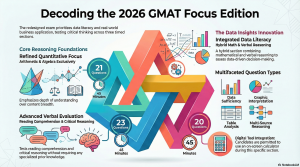
In the 2026 GMAT syllabus, the Quantitative Reasoning section consists of 21 multiple-choice questions to be completed in 45 minutes. It now exclusively covers topics in arithmetic and algebra.

This update ensures that GMAT evaluates how well candidates interpret data, apply logic, and solve problems under time pressure- skills crucial for business success.
Key Topics in GMAT Quantitative Reasoning (2026)
| Arithmetic Topics | Algebra Topics |
| Multiples and Factors | Algebraic Expressions and Equations |
| Number Properties and Estimation | Functions and Graphing |
| Fractions and Decimals | Exponents & Roots |
| Percentages | Linear and Quadratic Equations |
| Averages | Inequalities & Basic Statistics |
| Ratios and Proportions | Slope of a line, Intercepts of a line |
| Mixtures and Allegations | Permutations and Combinations |
| Rate, Time and Work Problems | Sequence and Series |
| Speed, Time, and Distance | Set Theory |
| Simple & Compound Interest | Descriptive Statistics |
| Probability | Measurement(Unit) Conversions |
This refined GMAT syllabus reflects the test’s evolution to better align with current business school expectations and industry needs. By narrowing the scope, the exam now prioritises depth of understanding and real-world application over breadth of content.
Read Also: GMAT Exam Pattern
GMAT Syllabus 2026: Verbal Reasoning Section Explained
The Verbal Reasoning section tests your ability to understand, interpret, and evaluate written material. The 2026 GMAT Focus Edition format consists of 23 multiple-choice questions, which must be answered within 45 minutes. It focuses on two primary areas- Reading Comprehension and Critical Reasoning.
Reading Comprehension
This question type includes a 200–350-word passage with multiple-choice questions. It tests analysis, inference, reasoning, and comprehension—not prior knowledge. You’ll face both short and long passages. More in-depth research can provide more accurate and detailed preparation strategies. These questions assess your ability to:
| Question Type | Skill Tested |
| Main Point | Identify and isolate the central idea of the passage |
| Supporting Idea | Understand relationships between different pieces of information |
| Inference | Logically deduce information without adding external assumptions |
| Function | Evaluate the purpose and role of individual elements within the passage |
| Application | Apply the logic of the passage to new situations or scenarios |
| Style and Tone | Interpret the author’s attitude and evaluate the rhetorical impact |
Critical Reasoning
Critical Reasoning questions in the GMAT verbal section are based on short passages (usually under 100 words), followed by five answer choices. These questions assess your ability to break down an argument, identify underlying assumptions, and evaluate the logic based on the provided information.
Skills measured include:
- Constructing and Evaluating an Argument.
- Identifying flaws or assumptions
- Strengthening or weakening arguments
- Drawing logical conclusions
This part of the GMAT syllabus is crucial for candidates who aim to sharpen their reasoning and decision-making abilities, which are essential for business school and beyond.
Together, the Verbal Reasoning section of the GMAT syllabus ensures that test-takers are equipped with the reading and analytical skills necessary for success in a data-driven, communication-intensive business world.
Read Also: GMAT Registration
GMAT Syllabus 2026: Data Insights Section Explained
One of the standout features of the updated GMAT Syllabus is the Data Insights section, introduced to reflect the growing importance of data interpretation skills in today’s business landscape. This section evaluates a candidate’s ability to assess information from various formats and apply logical, mathematical, and verbal reasoning to draw accurate conclusions.
This section of the GMAT Focus Edition syllabus includes 20 questions to be completed in 45 minutes. It allows the use of an on-screen calculator. It combines elements from both the Quantitative and Verbal sections, with a heavy focus on data literacy.
Types of Questions in the Data Insights Section
| Question Type | Skill Tested |
| Data Sufficiency | Determine whether the provided data is adequate to solve a given problem |
| Graphic Interpretation | Interpret and conclude visual data formats such as graphs and charts |
| Table Analysis | Understand and analyse structured data presented in table form |
| Two-Part Analysis | Tackle questions with multiple variables or interdependent factors |
| Multi-Source Reasoning | Synthesise information from various sources (text, charts, tables) to find logical answers. |
This section of the GMAT syllabus 2026 tests a wide array of abilities, including analytical thinking, data organisation, problem-solving, and decision-making, which are essential for success in modern business programs and corporate environments.
If you’re preparing for the GMAT this year, ensure your preparation strategy includes a strong focus on mastering Data Insights, which could significantly impact your overall score and performance.
Read More: GMAT Exam Centers
GMAT 2026 Paper Pattern Explained: Section-Wise Syllabus Overview
Here is the revised time allocation for each section of the GMAT exam as per the updated Focus Edition format:
| GMAT 2026 Section | No. of Questions | Time Allotted | What It Tests |
| Quantitative Reasoning | 21 questions | 45 minutes | Assesses quantitative reasoning and problem-solving abilities using math concepts |
| Verbal Reasoning | 23 questions | 45 minutes | Tests reading comprehension, critical reasoning, and the ability to read, comprehend passages, and evaluate arguments. |
| Data Insights | 20 questions | 45 minutes | Evaluates data literacy, interpretation, and analytical skills from multiple sources |
| Total | 64 questions | 135 minutes
(10 minute optional break) |
Comprehensive assessment across logic, language, and data-driven problem solving |
Read Also: GMAT Practice Test
Frequently Asked Questions
What is the syllabus for GMAT?
The GMAT Focus Edition syllabus is divided into three sections: Quantitative Reasoning, Verbal Reasoning, and Data Insights, each with a 45-minute time limit, totaling 2 hours and 15 minutes(plus a ten-minute optional break). This updated format excludes the Analytical Writing Assessment (AWA) and Sentence Correction sections, focusing more on relevant, modern business skills. Also, no geometry and DS question type from Quant is moved to DI section.
Is GMAT harder than JEE?
Not really- they’re difficult in different ways. JEE is more difficult regarding academic depth, especially in physics, chemistry and mathematics, and is designed for engineering aspirants. GMAT, while testing logic and reasoning, is more conceptual and business-focused. Difficulty depends on your background and preparation style. GMAT is more about logic, reasoning and analytical thinking. If you’re from a strong science/ engineering background, JEE will always feel much harder than GMAT.
Is GMAT tough or CAT?
It depends on your strengths. The GMAT and CAT are both competitive, but their difficulty varies by individual. GMAT emphasizes logic and reasoning, data analysis, with predictable patterns, making it easier for some. GMAT is more structured and predictable, with clear question patterns and a defined syllabus.CAT has tougher quantitative sections, unpredictable question types, and no official syllabus and the difficulty can vary each year. If you’re not comfortable with higher-level Quant and unpredictable formats, CAT feels tougher.
What changed in the GMAT after July 1, 2024?
Only the exam name reverted to “GMAT.” The syllabus, format, structure, and content remain exactly the same as the former Focus Edition.
Is a calculator allowed in the GMAT?
Yes, an on-screen calculator is provided only for the Data Insights section; it isn’t allowed in Quantitative Reasoning.
Is there any break between sections?
Yes, the GMAT offers one optional 10-minute break between sections, which you can choose to take or skip.
Is grammar tested in the GMAT?
Direct grammar questions aren’t tested. However, strong grammar helps in Reading and Critical Reasoning for clarity, comprehension, and evaluating arguments.