
What is the GMAT Scoring System?

26 March, 2026
GMAT Scoring System
The GMAT Focus Edition scoring system is on a scale from 205 to 805, based on three sections: Quantitative Reasoning, Verbal Reasoning, and Data Insights. Each section is scored from 60 to 90, one point at a time. GMAC then uses its own system to convert these into the 205–805 scale. According to the score chart, the 99th percentile starts at 705, so a 705 is often seen as the ‘elite’ GMAT score and is about the same as a 750 on the Classic GMAT.
The GMAT Focus Edition plays a major role in MBA admissions worldwide. Business schools consider your GMAT score along with your work experience and academic background to decide if you are a good fit for their programs.
The GMAT Focus Edition gives you a total score between 205 and 805. Your score comes from three sections—Quantitative Reasoning, Verbal Reasoning, and Data Insights—each worth between 60 and 90 points. The test is computer-adaptive, so the questions get harder or easier depending on how you answer.
Section
Score Range
Increments
Quantitative Reasoning 60-90 1 point
Verbal Reasoning 60-90 1 point
Data Insights 60-90 1 point

How is the GMAT Score Calculated?

The GMAT Focus Edition score is the summed-up score of all three sections.
Your total GMAT Focus Edition score is calculated by adding up your three section scores, each weighted the same. GMAC uses a computer-adaptive system that adjusts the questions you get based on your previous answers. The system looks at:
  • How many questions were answered correctly
  • How many questions were attempted
  • And the difficulty level of each question
All three sections feed into a single total score on the 205–805 scale.

What is the GMAT Score Chart?

The GMAT score chart helps you see how your section scores add up to your total score. It shows how different combinations of Quant and Verbal scores lead to your final results or score.

The GMAT Score Chart
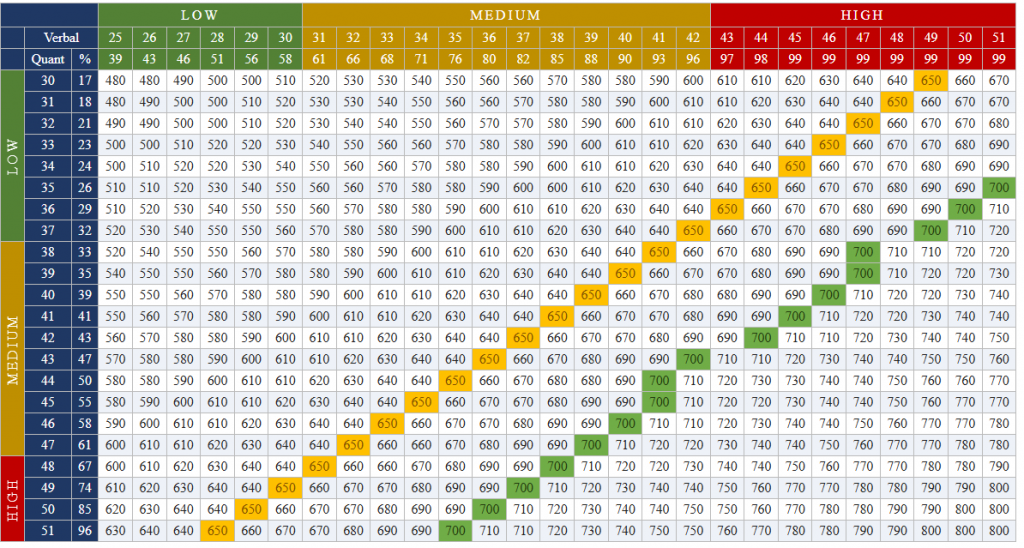
GMAT Score Chart

What is the GMAT Percentile?

The GMAT percentile shows how your score compares to other test-takers. For example, if you are in the 90th percentile, you did better than 90% of people who took the test. Rankings are updated each year, so your percentile might change a bit even if your score stays the same.
Higher your score, the higher your percentile and vice versa.
In 2014, GMAC introduced a score preview feature that lets test-takers cancel scores they are not happy with. This feature has led to higher average GMAT scores overall.

GMAT Score Chart: Overall Score vs Percentile Rankings

The table below shows how total GMAT Focus Edition scores (205–805) match up with percentile rankings, using GMAC’s official data. For example, a 75th percentile score means you did better than 75% of test-takers.

GMAT Total Score
Percentile
805 100%
725 99%
705 99%
685 97%
665 94%
645 89%
625 83%
605 75%
585 65%
565 56%
545 47%
525 38%
505 31%
485 24%
465 19%
445 14%
425 10%
405 8%
385 5%
365 4%
345 3%
325 2%
305 1%
205 0%

GMAT Score Chart: Section-Wise Percentile Rankings

Each section has its own percentile ranking. Here’s how each one breaks down.

Quantitative Reasoning

Quant Score
Percentile
51 96%
50 85%
49 74%
48 67%
45 54%
40 38%
35 25%
30 16%

Verbal Reasoning

Verbal Score
Percentile
51 99%
46 99%
40 90%
35 76%
30 58%
25 39%
20 22%
15 10%

Data Insights

DI Score
Percentile
90 100%
85 99%
81 90%
78 73%
75 51%
72 34%
71 28%

How is the GMAT Focus Edition Scoring System Different?

The GMAT Focus Edition scoring system is more efficient, uses adaptive testing, and has updated question formats compared to the classic GMAT. The classic version is more straightforward, with a different structure and scoring. Choosing between them depends on how you like to prepare, your timeline, and your personal preferences.
Feature
GMAT Classic
GMAT Focus Edition
Sections AWA, IR, Quant, Verbal Quant, Verbal, Data Insights
Duration ~3 hrs 30 min ~2 hrs 45 min
Score Range 200–800 205–805
Adaptive Testing Quant & Verbal only All sections
Exam Fee (online) USD 300 USD 413
Score Release Up to 20 days 3–5 days
Question Style Theory-based, mixed difficulty Application-focused, real-world scenarios

What is a Good GMAT Score?

A GMAT score of 655 or higher is considered good and can help you get into strong universities and programs. However, a score of 705 or above is ideal for admission to elite MBA programs. Scoring 705 or more puts you around the 98th percentile, which is best for top business schools worldwide.

GMAT Scores for Admissions to Top B-Schools
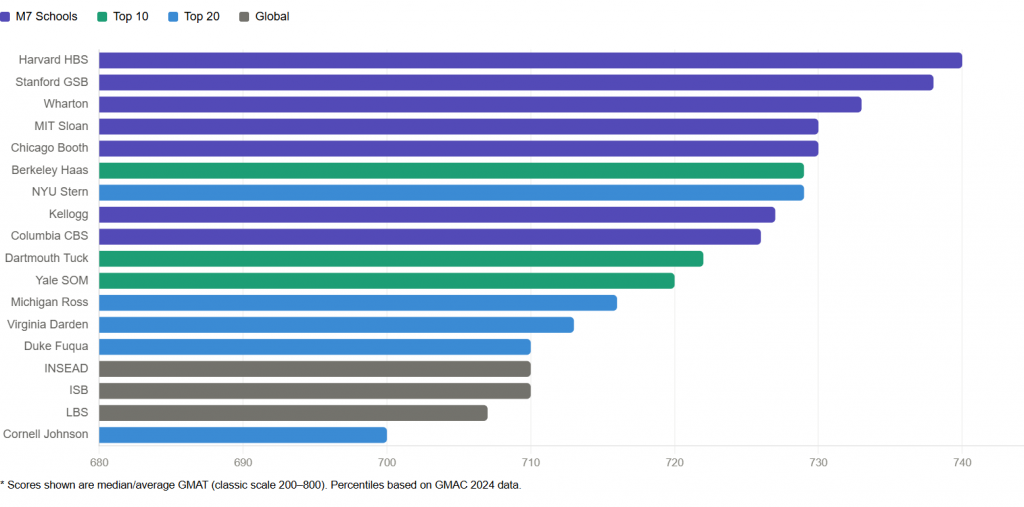
GMAT scores

What GMAT Percentiles Do Top Business Schools Want?

Top business schools around the world look for GMAT Focus Edition scores in the 90th percentile or above.
  • The top 10 MBA programs in the world want their candThe top 10 MBA programs expect candidates to be in the 96th percentile or higher, which means a score of 675 or above.nder 98th percentile.
  • UCLA is a bit more accessible, with a cutoff at the 94th percentile.

GMAT Percentiles for Admissions to Top B-Schools 
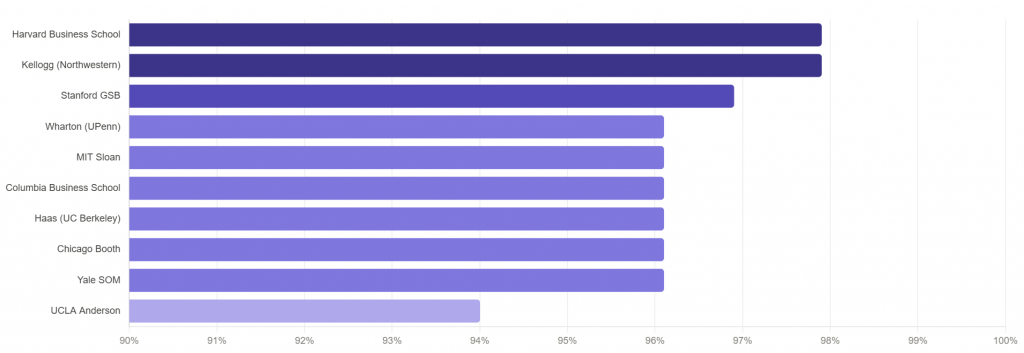
As a rule of thumb, aim for a score of 705 or higher if you want to get into one of the top 10 MBA programs worldwide.

School
Approx. Percentile
Harvard Business School ~98%
Kellogg School of Management ~98%
Stanford GSB ~97%
Wharton, MIT Sloan, Columbia, Haas, Chicago Booth, Yale SOM ~96%
UCLA Anderson ~94%

Sample GMAT Score Card

Your official GMAT score report shows your performance in each of the three sections, including your scaled score (60–90) and the percentile for each. It also lists your total score, the exam date, and is valid for five years from your test date.
A sample score report might look like this:
Section
Score
Percentile
Quantitative Reasoning 85 82%
Verbal Reasoning 87 88%
Data Insights 83 96%
Total
655 93%

What is GMAT Granular Scoring System?

The GMAT uses a detailed scoring scale, with single-point steps for each section and 10-point steps for the total score. This system offers several advantages over other exams. Even small improvements can lead to noticeable jumps in your percentile and real-world benefits.

Scholarship differentiation: Many business schools link financial aid to score ranges. Improving your score by 10 points at the higher end can move you into a more competitive scholarship group.

Resilience against minor errors: On the GMAT, dropping two points in a section only causes a small change in your percentile. On other exams, the same drop can lower your percentile by almost 10 points.

Holistic total score: The GMAT does not require minimum scores for each section. Instead, it combines all sections into one overall percentile. This benefits candidates who are strong in one area and solid in others.

Strategic section emphasis: If you are strong in quant, you can focus on that section and still achieve a 95th-percentile overall score. This lets you spend more time improving weaker areas.

What are the Advantages of the New GMAT Scoring System?

The GMAT Focus Edition is not just a shorter version of the Classic. It is a complete redesign based on what business schools really want to measure.
  1. Industry-relevant content: The Focus Edition matches modern MBA curriculum priorities, focusing more on applied reasoning than on memorizing formulas.
  2. Skill-focused design: Critical thinking, data interpretation, and verbal reasoning are given more weight, matching what top programs value most.
  3. Competitive differentiation: Choosing the newer format shows admissions teams that you are forward-thinking and up to date.
  4. Improved test experience: The shorter, simpler format helps reduce fatigue and can lead to better performance on test day.
  5. Scholarship potential: High Focus Edition scores can help you qualify for merit-based financial aid at top programs.
  6. Admissions alignment — The exam is more closely designed Admissions alignment: The exam is designed to match the criteria that modern business schools use, giving admissions officers clearer information.r-friendly interface helps candidates focus without unnecessary friction.
  7. Greater time efficiency: Even though the exam is shorter, it still measures all the important skills.
  8. Better school insight: The updated scoring system gives admissions committees more detailed and useful information about each applicant.
  9. Signals professional seriousness: Taking the latest version shows you are committed to staying current, which is a positive sign for evaluators.


GMAT Frequently Asked Questions

Yes, the GMAT and GMAT Focus Edition are the same. The GMAT Focus Edition was introduced on November 7, 2023, and, as of 2025, has replaced the classic edition of the GMAT, which ceased to exist beyond 31st Jan 2024. Interestingly, after 31st May 2024, GMAC designated the GMAT Focus Edition as ‘The GMAT’ and removed “Focus Edition” from the nomenclature. The current GMAT has a shorter overall test time, a reduced number of sections, and a different scoring scale. It is now the only version of the exam available. So, YES, GMAT and GMAT Focus are the same.

Yes, you can share your official GMAT Score Report with 5 universities for free within 48 hours of the scores being made available. The Official Score Report will contain the Total and Section scores from the single exam. 

Yes, around 200 programs from 140+ colleges in India accept GMAT scores for MBA admissions. Top institutes like the Indian School of Business (ISB), Indian Institutes of Management (IIMs) accept the GMAT for their executive MBA programs, while schools like XLRI and SPJIMR recognize GMAT scores for full-time programs in India. Connect with our consultants to know more about the schools based on your profile analysis.

Yes, around 200 programs from 140+ colleges in India accept GMAT scores for MBA admission. Top institutions like the Indian School of Business (ISB), Indian Institutes of Management (IIMs) for their executive MBA programs, XLRI, and SPJIMR recognize GMAT scores for full-time programs in India. 

The IMS Manya Online GMAT  Coaching Program is comprehensive and covers all the aspects of verbal, quant, and DI for the GMAT. The curriculum is updated to reflect the new GMAT Focus Edition and offers exhaustive in-class exposure and practice material. You won’t need any other resources or help to complete your GMAT syllabus and score 665+.

The IMS Manya Online GMAT Coaching Program is comprehensive and covers all the aspects of verbal, quant, and DI for the GMAT. The curriculum is updated to reflect the new GMAT Focus Edition and offers exhaustive in-class exposure and practice material. You won’t need any other resources or help to complete your GMAT syllabus and score 705+.

The IMS TPR Online GMAT Coaching Program covers all the aspects of Verbal, Quant, and DI for the GMAT. The curriculum is updated to reflect the current GMAT format, offers exhaustive in-class practice content on a user-friendly TPR portal, and customised 1-1 mentoring. The program is unique because it relies on real GMAT questions coupled with the 6 official MBA.com tests. You won’t have to look beyond these resources or help to prepare for your GMAT and score 705+.

While most colleges abroad don’t have any hard GMAT score cutoffs, it is advised to score within the 25th and 75th percentile range for your target college. Colleges abroad take a holistic view of your entire application, giving you the freedom to apply wherever you want. However, a high GMAT score that is above the median GMAT score of your target college will improve your chances of admission.

The GMAT demo class is the perfect opportunity to interact with our mentors and experience an entire lesson for yourself. It’ll help you understand our pedagogy, teaching methodologies, and learning experience.

While most colleges abroad don’t have any hard GMAT score cutoffs, it is advised to score within the 25th and 75th percentile range for your target college. Colleges abroad take a holistic view of your entire application, giving you the freedom to apply wherever you want. However, a high GMAT score that is above the median GMAT score of your target college will improve your chances of admission.

As part of the GMAT coaching program, IMS Manya offers 30 one-on-one mentoring sessions, in addition to 65+ hours of live learning, with some of the most experienced mentors. In these sessions, you can work with your assigned mentor to build GMAT preparation strategies, refine your approach to problem-solving, resolve individual doubts, analyse your mock tests, and get tips on how to apply to the right colleges.

As part of the Online GMAT coaching program, IMS Manya offers 30 one-on-one mentoring sessions, in addition to 65+ hours of live learning, with some of the most experienced mentors. In these sessions, you can work with your assigned mentor to build GMAT preparation strategies, refine your approach to problem-solving, resolve individual doubts, analyse your mock tests, and get tips on how to apply to the right colleges.

As part of the GMAT coaching program, IMS Manya provides 30 one-on-one mentoring sessions alongside 65+ hours of live instruction led by highly experienced mentors. These personalized sessions help you develop a structured GMAT preparation strategy, sharpen your problem-solving approach, clarify individual doubts, conduct in-depth mock test analysis, and receive guidance on selecting and applying to the right business schools.

The 30 Myplans with your mentor help you track and accelerate your performance progress. Working one-on-one with your academic mentor, you’ll set personalized study goals, refine problem-solving techniques, analyze mock test performance in depth, and optimize test-taking strategies. These sessions ensure you receive expert, data-driven guidance tailored to your SAT readiness and score goals.

A strong score on the GMAT Focus Edition is typically in the 675–705 range, aligning roughly with the traditional GMAT score of 700. Specifically, a 705+ score is around the 98th percentile, while a 645 score equates to the traditional 700 and corresponds to the 88th percentile. Ultimately, you should always aim for a score that is higher than your target B-Schools. 

Benchmark your score against the average GMAT of your target B-schools. A strong GMAT Focus score is typically 675–705, with 705+ around the 98th percentile and 645 roughly equivalent to a traditional 700 (88th percentile). Aim to score above your target schools’ averages to stay competitive.

The GMAT is a 2-hour 15-minute computer-adaptive test comprising three 45-minute sections: Quantitative Reasoning – 21 Problem-Solving questions, Verbal Reasoning – 23 Reading Comprehension and Critical Reasoning questions, and Data Insights – 20 questions covering Data Sufficiency, Table analysis, Graphics Interpretation, Multi-Source Reasoning, and Two-Part Analysis. The test adapts to your performance level, making accuracy and strategic pacing critical for obtaining a high score.

The GMAT (Graduate Management Admission Test) is a standardized computer-adaptive test administered by the Graduate Management Admission Council (GMAC). It assesses skills essential for success in graduate business programs, such as problem-solving, critical thinking, and data analysis. It enables business schools to compare candidates from diverse backgrounds and is preferred over other tests.

The GMAT scoring structure is as follows: Final Scaled Score: 205–805 in increments of 10 points & Sectional Scores: 60–90 in 1-point increments, for each of the three sections. The final score is derived from performance across Quantitative Reasoning, Verbal Reasoning, and Data Insights. Scores are percentile-ranked relative to global test-takers.

While the score improvement is not guaranteed, our time-tested GMAT coaching methodologies, The Princeton Review approved pedagogy, and constant mentor support have enabled our students to improve their GMAT score by 83 points on average.

Yes. GMAT® allows you to cancel your GMAT® score during ‘Score Preview’ at the test venue as well as within 72 hours of the test.

You can cancel your test score during the ‘Score Preview’ just after the test.

You can cancel your test score later – within 72 hours of taking the test by paying a fee of USD 25.

Yes. A cancelled GMAT® score can be re-instated up to 4 years and 11 months from the date of exam by paying a fee of USD 50.

The fee for taking the GMAT test in a test centre is $275 (₹23,479), and when taken online, the fee is $300 (₹25,613). For rescheduling within 14 days or less, the test centre fee is $165 (₹13,695), and online is $180 (₹14,940). For detailed information on cancellations and rescheduling, please refer to the official website, www.mba.com