

SAT Exam Pattern 2026: Section-wise Structure, Format, Negative Marking & Prep Tips
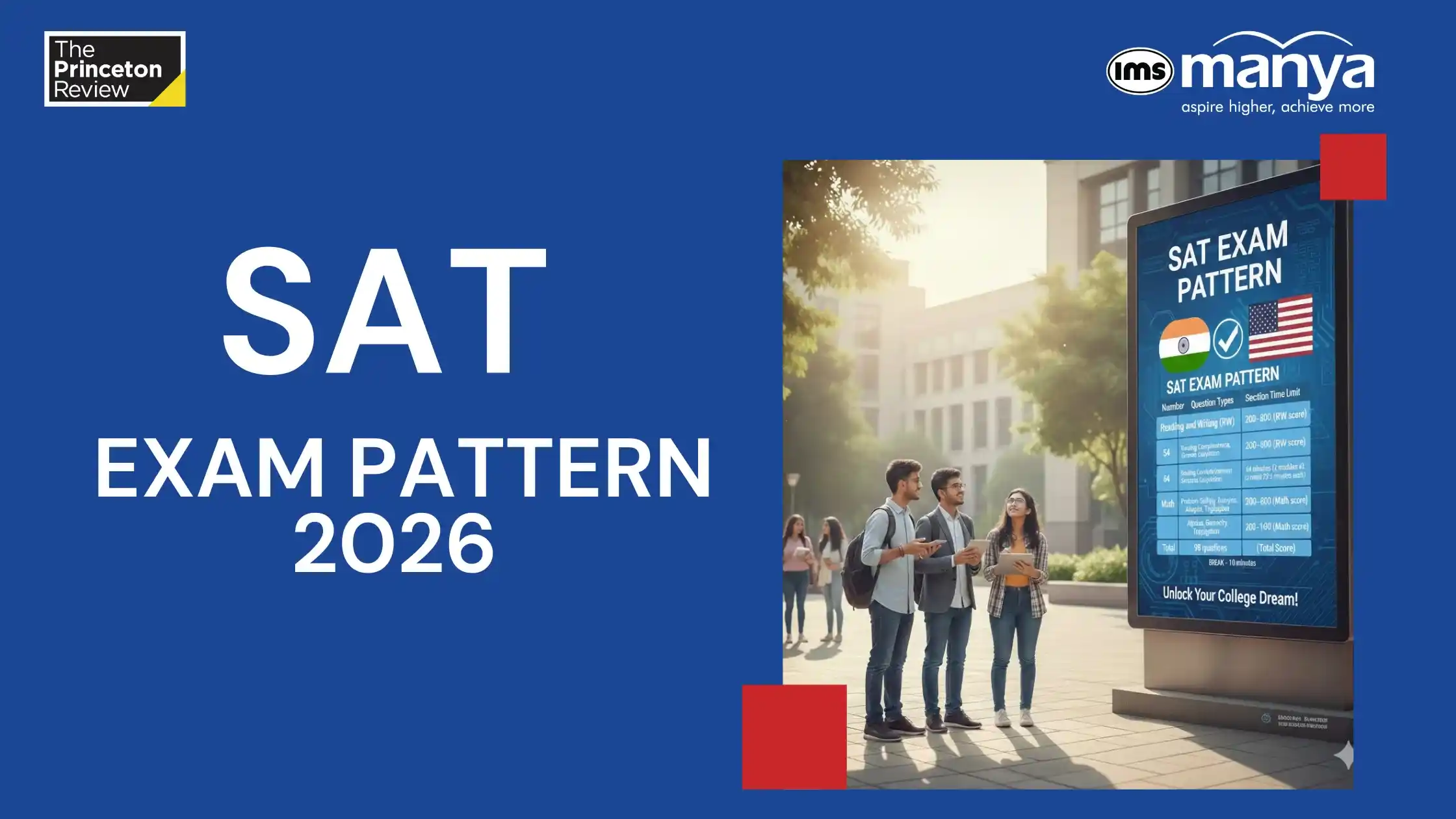
The SAT Exam Pattern 2026 follows a fully digital and adaptive format designed to assess students’ reading, writing, and mathematical skills efficiently. The Digital SAT consists of two main sections—Reading & Writing and Math—with a total of 98 questions to be completed in 2 hours and 24 minutes.
Understanding the latest SAT pattern, marking scheme, and section-wise distribution is crucial for effective preparation and achieving a high score.It is scored on a 400-1600 scale, without negative marking. The format is divided into two modules per section, where performance in the first determines the difficulty of the second.
SAT Exam Pattern 2026
The updated SAT pattern for 2026 is summarised below:
| SAT Exam Section | Number of Questions | Question Types | Section Time Limit | Score Range |
| Reading and Writing (RW) | 54 questions | Reading Comprehension, Grammar, Sentence Completion | 64 minutes (2 modules of 32 minutes each) | 200–800 (RW score) |
| BREAK- 10 minutes | ||||
| Math | 44 questions | Problem Solving, Data Analysis, Algebra, Geometry, Trigonometry | 70 minutes (2 modules of 35 minutes each) | 200–800 (Math score) |
| Total | 98 questions | Reading and Writing, Math | 144 minutes (2 hours 24 minutes) |
The majority of SAT questions are multiple-choice, but a few math questions require students to enter their answers manually, rather than choosing from given options.
Penalty or Negative Marking in SAT Exam
The SAT exam pattern does not include negative marking, meaning students are not penalised for wrong answers. This makes it advantageous to attempt all questions, even if unsure of the correct response.
SAT Marking Scheme 2026
The SAT follows a simple scoring system:
- No negative marking
- Each correct answer earns points
- Total score ranges from 400 to 1600
- Section-wise scoring: 200–800 each
Since there is no penalty for wrong answers, students should attempt all questions.
What is the SAT Exam Pattern 2026?
The Digital SAT 2026 consists of two sections—Reading & Writing and Math—with 98 total questions. The test lasts 2 hours 24 minutes and follows an adaptive module-based format without negative marking.
Key Highlights of SAT Pattern
- Smart Guessing Helps: Because there’s no negative marking, strategic guessing increases your chances of scoring higher.
- Adaptive Test Format: Each section has two modules; performance in Module 1 determines the difficulty level of Module 2.
- Shorter Passages: Each RW question is tied to a brief passage (25–150 words).
- Calculator Allowed Throughout Math: A built-in Desmos graphing calculator is available.
SAT Sections and Timing- SAT Math Section (2026)
The SAT Math section is an important part of evaluating the student’s college readiness. According to the updated SAT exam pattern 2026, this section comprises a combination of multiple-choice questions and Student-Produced Response (SPR) questions, where students must calculate and enter their answers themselves.
SAT Math Pattern: Topic-Wise Breakdown
- Algebra: 13-15 questions.(35%)
- Advanced Math: 13-15 questions (35%)
- Problem Solving & Data Analysis: 5-7 questions (15%)
- Geometry and Trigonometry: 5-7 questions (15%)
Key Topics in the SAT Math Syllabus
| SAT Math Topic | Key Concepts Covered |
| Algebra | Linear equations, systems of equations, inequalities |
| Advanced Math | Quadratic equations, polynomials, exponents, rational expressions |
| Problem Solving & Data Analysis | Ratios, percentages, data interpretation, statistics, probability |
| Geometry & Trigonometry | Circles, triangles,quadrilaterals, basic trigonometric functions, area and volume. |
Being familiar with the SAT pattern and knowing how the questions are spread across topics enables focused preparation. By mastering each category within the SAT math syllabus, candidates can significantly improve their performance in the exam.
SAT Exam Pattern – SAT Evidence-Based Reading and Writing (2026)
The SAT Reading and Writing section assesses a student’s comprehension, reasoning, and grammar skills through various question formats. According to the latest SAT exam pattern 2026, this section measures reading accuracy and language proficiency.
Major Question Types:
- Reading Comprehension: Based on short passages (ranging from 25- 150 words), students must answer questions about main ideas, tone, purpose, and supporting details.
- Evidence-Based Questions: Test-takers choose relevant textual evidence to support previous answers, evaluating their critical thinking and connection-making abilities.
- Grammar and Language: Questions focus on correcting sentence structure, punctuation, and grammar usage errors.
- Revising and Editing: Students improve the written passages’ clarity, organisation, and effectiveness.
Question Distribution by Skills
| Skill Area | Number of Questions | Approximate Weightage |
| Craft and Structure | 13–15 questions | 28% |
| Information and Ideas | 12–14 questions | 26% |
| Standard English Conventions | 11–15 questions | 26% |
| Expression of Ideas | 8–12 questions | 20% |
Understanding the SAT pattern for Reading and Writing is crucial for targeted preparation. Focusing on these skill areas can help you maximise your score on the 2026 SAT.
SAT Preparation Tips 2026
| Preparation Aspect | Details (2026 Context) |
| Build a Study Plan | Create a structured study schedule that will balance your high school curriculum with SAT exam preparation. |
| Focus on Targeted Practice | Take full-length mocks, analyze results to spot weak areas, and plan targeted official SAT practice to improve efficiently and save time. |
| Build Academic Vocabulary | Strengthen your vocabulary with a focus on academic and contextual words commonly seen in the SAT Reading and Writing section. |
| Time Management | Developing pacing strategies and timing yourself strengthens time management and boosts performance on the SAT. |
| Meet with experts | Use feedback from mentors or peers to identify gaps and create a customized plan for your next milestone. |
Frequently Asked Questions
Is SAT adaptive?
Yes, the Digital SAT is adaptive. Each section has two modules, and your performance in the first module determines the difficulty of the second.
What is the format of the SAT?
2026 Digital SAT format contains: Reading and Writing, Math, and the SAT essay has been completely discontinued (not optional anymore). Test-takers have 64 minutes for the Reading and Writing section and 70 minutes for the Math section, with a 10-minute break in between. This results in a total exam duration of approximately 2 hours and 24 minutes.
Is SAT difficult than JEE?
Generally, the JEE (Joint Entrance Examination) is considered more challenging than the SAT (Scholastic Assessment Test). The JEE—particularly the Advanced stage—requires in-depth knowledge of core subjects such as physics, chemistry, and mathematics, as well as strong analytical and problem-solving skills. On the other hand, the SAT emphasises critical reading, writing, and basic math skills, and involves comparatively straightforward concepts.
Is SAT very difficult?
The SAT is strategically challenging, not academically difficult. It tests core skills, not advanced or obscure knowledge.While around 90% of students typically get the easy questions right, fewer than 30% correctly answer the difficult ones. To gauge the SAT’s challenge, take a full-length official mock test on the College Board Bluebook app for a realistic experience of its timing and adaptive format.
Is SAT 1600 or 2400?
The SAT is scored on a scale of 400 to 1600, not 2400. This total score combines two sections: Reading and Writing (200–800) and Math (200–800). The previous 2400-point format, which included a separate Writing section, was discontinued in 2016. The current SAT follows the 1600-point scale.
Is SAT an adaptive exam?
Each section is divided into 2 equal length modules. The first module of each section contains a broad mix of easy, medium, and hard questions. Based on how you perform on the first module, the second module of questions will either be more difficult or less difficult.