

SAT Preparation 2026: Step-by-Step Guide, Strategies, Resources & Tips

How to Prepare for SAT? To prepare for SAT, begin with a structured study plan a few months in advance, tailor it to focus on your weak areas, use official practice material, build strong reading habits, apply what you learnt in school to reinforce your vocab and math skills, regularly practice your tests, focus on time management, and approach questions with logical elimination instead of guessing.
Students typically opt for one of two approaches to SAT preparation: self-study or enrolling in coaching classes. Both methods offer distinct advantages and can be equally effective, depending on the student’s learning style. Since the SAT exam is primarily taken by students seeking undergraduate admissions directly after high school, it’s essential to start preparing early.
To guide students on how to prepare for the SAT 2025, some practical and free strategies include practicing with official SAT resources, attempting atleast one full-length mock test via Bluebook, and staying attentive in high school coursework. This blog has compiled the most effective methods and expert-recommended SAT preparation strategies to help you study smarter and score higher.
SAT Preparation Guide: Best Tips to Begin Your Study Journey
When it comes to SAT preparation, starting with the right approach can make a significant difference in your score. The SAT exam is a crucial step for high school students aiming for undergraduate admissions in top global universities. If you’re wondering how to prepare for SAT 2025, this guide will walk you through the most effective tips and strategies for acing the exam confidently.
Start Your SAT Preparation Early
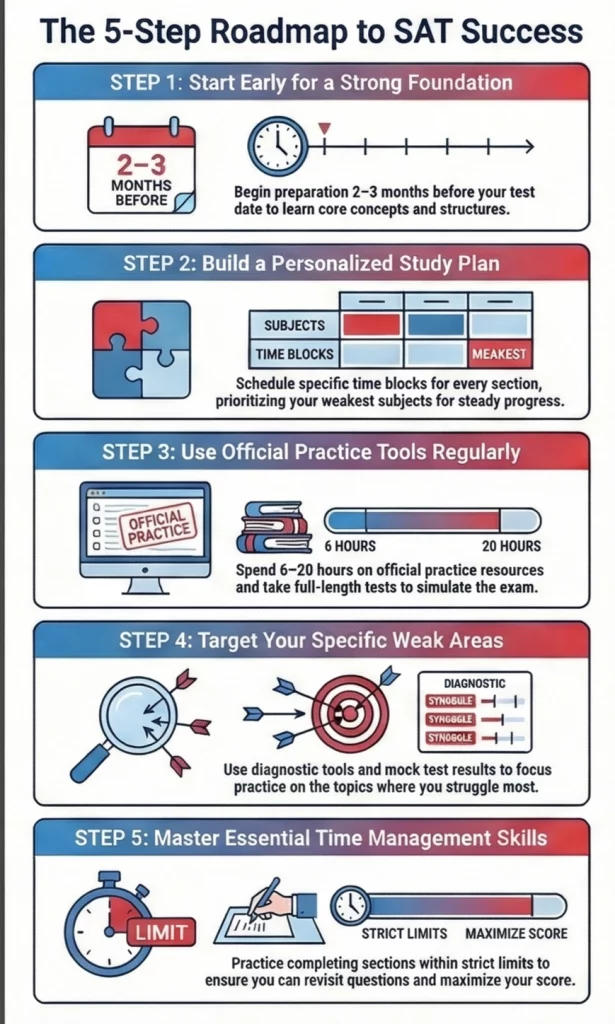
One of the best tips on how to prepare for SAT is to begin early. Ideally, students should start their SAT preparation during high school, well before their chosen test date. Understanding the SAT syllabus and exam structure early allows you to create a realistic prep schedule. Give yourself atleast 2-3 months to prepare thoroughly by learning concepts, revising regularly, and taking mock tests.
Read More: SAT Exam
Build a Personalised SAT Study Plan
Creating a structured and realistic study plan is a core part of effective SAT preparation. Choose a target test date and build your schedule around it. Includes time blocks for each section of the SAT, focusing more on your weaker areas. A well-balanced plan ensures that you stay consistent and make steady progress as you prepare for the exam.
Use Official SAT Practice Tools
If you’re researching how to prepare for SAT, using Official SAT Practice is recommended. Developed in partnership with the College Board, these free resources provide personalized practice plans based on your skill level and goals. It’s a reliable and efficient way to prepare for the SAT exam. Spend atleast 6-20 hours practicing and follow it up with a full-length test on Bluebook to simulate the real test experiences.
Use Your School Learning to Your Advantage
Since the SAT exam content closely aligns with high school curricula, being attentive in class is essential to SAT preparation. Understand the fundamental concepts and seek clarification on any doubts in class. Focus on vocabulary development, especially for the Reading and Writing (RW) section, to boost your overall score.
Take Regular SAT Practice Tests
A vital step in how to prepare for SAT is to take frequent mock tests. These tests are important to measuring your progress, improving time management, and identifying your strengths and weaknesses. Analyze your performance after every practice test and make adjustments in your study plan accordingly. This form of SAT preparation builds confidence and helps you reduce test anxiety.
Read More to Improve Comprehension
Regular reading habits are essential for SAT preparation, especially for the Reading and Writing sections. Read editorials, academic essays, journals, and fiction to build your vocabulary and comprehension skills. Daily reading will not only help with the SAT but also improve your overall communication skills- an added advantage when applying to study abroad.
Read More: SAT Eligibility
Master Time Management Skills
One key aspect of how to prepare for SAT is learning how to manage your time effectively during the exam. Practice completing sections within the time limits and avoid spending too long on one question. Effective time management helps you complete the test on time, revisit skipped questions, and maximize your final score.
Focus on Weak Areas with Targeted Practice
Use your practice test results to identify areas where you’re struggling and invest more time improving those specific topics. Tools like Skill Insight™ by College Board offer valuable diagnostics to support your targeted SAT preparation. This efficient strategy helps you concentrate on what matters instead of revising everything.
Avoid Predicting Answer Patterns
Don’t fall into the trap of guessing answers based on patterns in previous questions. Instead, rely on logic, elimination techniques, and what you’ve learned through practice. A smart and analytical approach is a must for strong SAT preparation.
How to Prepare for SAT Exam: Timeline

| Time Before SAT | Preparation Strategy | Goal |
| 6 Months Before Exam | – Understand SAT exam pattern & syllabus
– Set target score – Create a study schedule |
Build foundation and set clear objectives for SAT preparation |
| 5 Months Before Exam | – Start concept learning (Math, Reading & Writing)
– Use Khan Academy SAT Practice – Begin light reading |
Strengthen conceptual understanding and develop early reading habits |
| 4 Months Before Exam | – Take first diagnostic test
– Identify strengths and weaknesses – Adjust study plan accordingly |
Begin targeted preparation based on diagnostic results |
| 3 Months Before Exam | – Focus on weak areas
– Practice sectional tests – Continue vocabulary building |
Improve section-wise accuracy and reinforce time management strategies |
| 2 Months Before Exam | – Take full-length SAT practice test weekly (on Bluebook)
– Analyze performance – Refine techniques |
Simulate test day experience and fine-tune strategies |
| 1 Month Before Exam | – Focused revision
– Daily timed practice – Review error log regularly |
Boost confidence and accuracy in all SAT sections |
| 2 Weeks Before Exam | – Take at least 2 full-length mock tests
– Focus on high-weightage question types |
Finalize timing strategy and reduce mistakes |
| 1 Week Before Exam | – Light revision only
– Avoid new topics – Rest adequately |
Avoid burnout; stay mentally and physically prepared |
| 1 Day Before Exam | – Pack essentials (ID, calculator, stationery)
– Light reading – Sleep well |
Stay relaxed, organized, and ready for SAT test day |
Read Also: SAT Registration
SAT Preparation Section-Wise Tips 2026
Since the SAT exam 2025 evaluates students in two key areas—reading and writing and Mathematics—it’s important to craft a smart and effective SAT preparation plan that covers both sections with strong conceptual understanding and ample practice. For students wondering how to prepare for the SAT, a section-wise approach can make the entire process more manageable and goal-oriented.
With the proper techniques, study resources, and consistent practice, candidates can successfully tackle both sections and maximise their score. Below, we’ve outlined the most effective SAT section-wise preparation strategies to help you crack the test in a single attempt.
Digital SAT Preparation Tips for Reading and Writing (RW) Section
| SAT RW Preparation Tip | Details |
| Learn Greek & Latin Roots | Helps decode complex Tier 2 vocabulary; e.g., bio = life, phil = love |
| Create Flashcards | Include word roots, definitions, and example sentences |
| Focus on Academic Vocabulary | Learn words commonly used in arguments and rhetorical writing |
| Use Chunk Reading | Read in groups of 3–5 words to increase speed and comprehension |
| Practice with Complex Passages | Read science, history, and social studies texts to build critical reading skills |
| Identify Key Elements | Focus on tone, author’s intent, and main ideas |
| Skim Questions First | Identify key line numbers or specific ideas before reading |
| Read with a Purpose | Avoid reading aimlessly; look for targeted information |
| Watch for Extreme Words | Avoid answers with “always,” “never,” etc., unless strongly supported |
| Beware of Keyword Echoes | Eliminate answers that only sound correct but lack meaning |
| Stay Within the Scope | Don’t choose answers with unsupported or unrelated information |
| Understand Passage Types | Some passages require error correction; others test comprehension |
| Master Grammar Rules | Focus on sentence structure, word choice, punctuation, and clarity |
Digital SAT Preparation 2026 Tips for Math Section
| SAT Math Preparation Tip | Details |
| Use Diagnostic Quizzes | Target weak areas in algebra, geometry, data analysis, and functions |
| Apply the 80/20 Rule | Identify and fix topics that cause most of your errors |
| Practice Higher-Difficulty Problems | Digital SAT adapts to performance; prepare for tougher questions |
| Simulate a Digital Test Environment | Practice eliminating options and showing work clearly on paper |
| Flag Hard Questions | Mark and return later to avoid wasting time |
| Time Your Practice in Chunks | Build endurance and learn pacing per section |
| Understand Questions Thoroughly | Don’t rush; analyze the problem before solving |
| Watch for Common Mistakes | Avoid falling for trap answers or partial solutions |
| Double Check Calculations | Look out for sign errors, unit mismatches, or step skips |
| Use a Calculator Wisely | Calculators are allowed in both math modules—practice efficient use |
Best Books for SAT Preparation 2026
Best Books for SAT Reading & Writing Section
| Book/Resource | Details |
| Classical Novels & Literature | Helps improve comprehension, vocabulary, and reading speed for SAT passages |
| Unabridged Books | Great for understanding complex sentence structures and diverse writing styles |
| The Critical Reader: The Complete Guide to SAT Reading (3rd Edition) | Highly recommended for mastering SAT Reading question types and strategies |
Best Books for SAT Math Section
| Book/Resource | Details |
| High School Math Textbooks | Essential for building strong conceptual clarity in Algebra, Geometry, and Statistics |
| 500 New SAT Math Problems by Dr. Steve Warner | Covers problem-solving techniques and offers a wide range of difficulty levels |
| 800+ Math Workbook New Edition by Dr. Jang’s SAT | Targeted practice for high scorers with advanced-level SAT math problems |
Read More: SAT Exam Fees